15-Door ABS Employee Locker: Compact Multi-User Storage for Modern Offices
15 Doors, One Wall: The Space Math That Works for Offices
An office with 30 employees doesn’t have room for 30 full-height lockers. It has room for two columns of this 15-door unit against the break room wall. That’s 30 people served from roughly 2.3 meters of wall space.
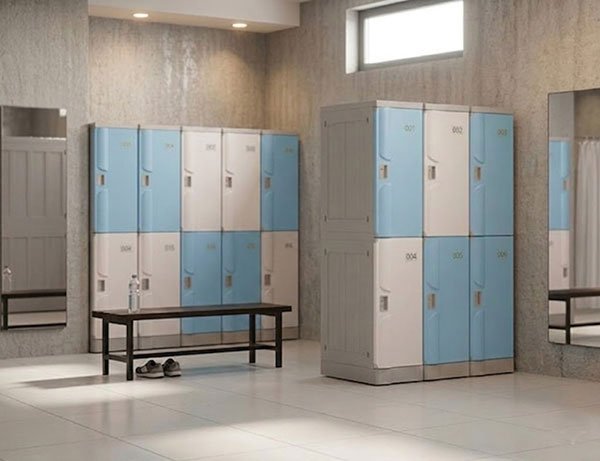
Each compartment holds what office workers actually store: a laptop bag, a lunch box, a spare pair of shoes, maybe a gym kit. The door is compact enough that 15 of them fit in a column that doesn’t dominate the room. At 400mm deep — less than a standard filing cabinet — it stays clear of walking paths.
The Hot-Desking Problem Nobody Solved Until Now
Post-pandemic office layouts have changed. More companies run hot-desking or hybrid schedules — employees don’t have assigned desks, but they still have stuff. A laptop. A headset. Notepads. Personal items they’d rather not carry on the train every day.
A 15-door ABS locker unit gives each employee a permanent anchor point. Assigned by door number, not by desk location. When the desk changes, the locker doesn’t. This solves the “where do I put my things” question that hot-desking creates and most office managers overlook until employees start complaining.
We’ve seen offices where employees claimed lockers informally — they’d leave a Post-it on the door and hope nobody moved their stuff. That system lasts about a week before someone’s gym bag ends up in the lost and found. A formal assignment with numbered doors and a simple spreadsheet ends the chaos. One HR manager told us it was “the cheapest employee satisfaction improvement we made all year.”
ABS vs the Office Environment
Offices aren’t as harsh as factories or pools, but they have their own locker problems:
- Coffee spills. A latte tipped over inside a metal locker pools at the bottom and rusts the seam within weeks. ABS — wipe it out, no damage, no smell.
- Cleaning crews. Night cleaning staff use floor buffers that splash water onto locker bases. Metal lockers rust upward from the bottom edge. ABS doesn’t absorb anything.
- Air conditioning cycling. Offices that shut off AC overnight and restart in the morning create condensation cycles. Metal expands and contracts — doors start sticking. ABS is dimensionally stable across the full indoor temperature range.
Numbering and Access Control That Scales
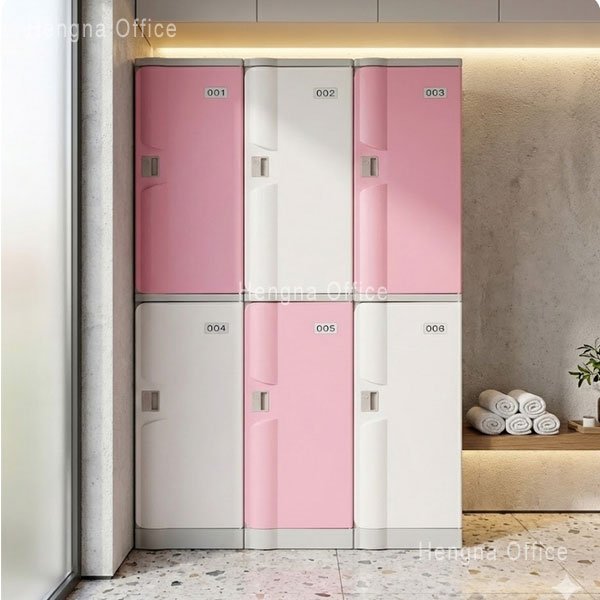
Each door has a recessed number plate — 001 through 015, permanently marked. No stickers that peel. No labels that need updating when someone leaves. The facility manager assigns door numbers to employees in a spreadsheet and hands out keys or combinations.
Lock options for office environments:
- Keyed-alike cam locks. Each door has its own key, facility management holds a master. Lost key? Master opens it, new lock cylinder installed in one minute.
- Built-in combination. No keys to distribute, collect, or replace. At employee offboarding, reset the combination. Done.
- RFID tap locks. Integrated with the building access card. Employee taps the same card that opens the front door. Audit trail shows who accessed which locker and when.
Installation in Existing Buildings
The modular snap-fit design means these units go into buildings without construction work. No welding. No bolting to the floor (optional wall anchoring for seismic zones). Two people carry a column through standard doorways and assemble it in the break room, hallway, or underused corner. For multi-floor offices, place columns on each floor rather than one central locker room — employees store items on their own floor, no elevator trips for a forgotten umbrella.
Appearance: Not the High School Grey Box
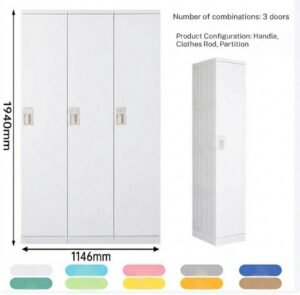
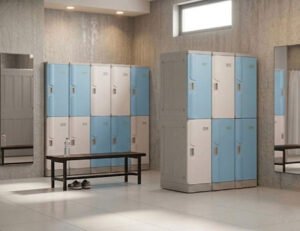
Traditional metal office lockers look institutional — grey, boxy, the kind of thing hidden in a basement. ABS lockers come in white, light grey, blue, and custom colors that work in a modern office. These units can sit in an open-plan area next to the kitchenette without dragging down the aesthetic. For companies trying to make the office a place people want to be, this detail matters more than any number on a spec sheet. We’ve had interior designers specify our locker colors to match the office palette — something that never happens with grey steel boxes.
The Retention Angle Nobody Talks About
Office managers talk about lockers as storage. HR directors talk about them differently. When an employee has a secure, assigned place to store personal items — gym clothes, a change of shoes, a laptop bag they don’t want to lug home on the train — the office becomes more than a desk. It becomes their space. In hybrid work environments where employees choose between home and office each day, the little things tip the balance. A locker with your name and combination code is a small reason to choose the office. It sounds trivial, but HR directors at companies with 15-door ABS installations tell us locker assignment is one of the most-requested amenities during onboarding. The cost per employee works out to less than the monthly coffee budget for a small team. For retention ROI, it’s hard to find a cheaper physical improvement to the workplace.
FAQ
Q: What are the exact dimensions?
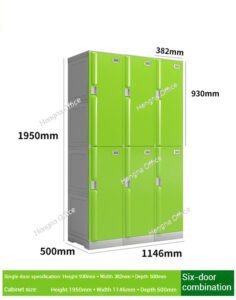
A: Each compartment is 382mm wide × 310mm tall × 400mm deep. One 15-door column is approximately 1146mm wide × 1950mm tall × 420mm deep. Request a dimensioned drawing for your configuration.
Q: Can I start small and add more later?
A: Yes. Columns are independent — buy two now, add two next year. They lock together side by side but don’t depend on each other structurally.
Q: What’s different vs school lockers of the same size?
A: Office units use muted colors, quieter door mechanisms, and lock types that integrate with building access systems. Structurally similar, visually and functionally office-focused.
Q: How does pricing compare to traditional metal office lockers?
A: ABS lockers cost more upfront than painted steel, roughly 30–50% depending on configuration and lock type. The difference closes by year 5 when you factor in zero repainting, zero rust repair, and zero door realignment. For offices planning to stay in the same space for 5+ years, the total cost of ownership favors ABS. For short-term leased offices with a 2-year horizon, steel may make more sense — we will tell you that directly.