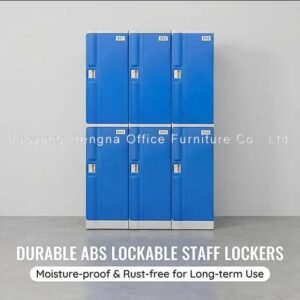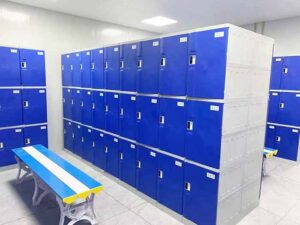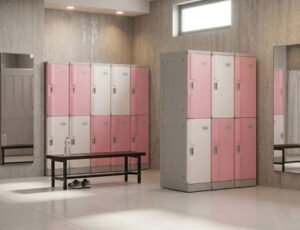
Antimicrobial Dual-Zone ABS Staff Locker – 6-Door Clean/Dirty | for Hospital Change Rooms
Hospital staff change rooms have a requirement that standard lockers cannot meet: clean and dirty separation. Nurses and doctors arrive in street clothes, change into scrubs, and at the end of a shift need a place for soiled uniforms that will not contaminate clean storage. A single-compartment locker forces staff to mix clean items with worn scrubs—a hygiene risk that infection control teams flag during audits.
Why Metal Lockers Fail in Hospitals
Steel lockers in hospital change rooms create infection control problems. Paint chips become bacterial traps—the microscopic gaps between chipped paint and bare metal are impossible to clean properly. Metal lockers dent when IV poles or equipment carts bump them, creating more crevices. Constant humidity from showers causes rust within 2-3 years, particularly in tropical-climate hospitals.
Surface degradation issues:
- Paint chips create rough surfaces where bacteria colonize
- Dents and scratches harbor pathogens that cleaning cannot reach
- Rust spots are porous and impossible to fully sanitize
- Seams and joints collect organic matter over time
A study in a 500-bed hospital found that metal locker surfaces had 3-5 times higher bacterial counts than ABS plastic surfaces after identical cleaning protocols. Metal lockers showed visible paint degradation within 18 months, while ABS lockers maintained smooth, cleanable surfaces.

Dual-Zone Design: Meeting Infection Control Requirements
The dual-zone compartment design addresses a critical healthcare need: separation of clean and contaminated items. Each locker door opens to reveal two distinct zones:
Upper zone (clean storage): Clean scrubs, personal clothing, clean shoes, personal items
Lower zone (dirty storage): Soiled scrubs after shifts, used protective equipment, wet or contaminated items
Why separation matters:
- Physical barrier prevents cross-contamination
- Ventilation allows dirty items to dry, reducing bacterial growth
- Clear visual separation reinforces proper hygiene practices
- Supports hospital infection control protocols
Without separation, clean clothes contact contaminated scrubs, pathogens transfer to personal items, and staff may take contaminated items home—increasing healthcare-associated infection risks.
Antimicrobial Dual-Zone ABS Staff Locker Specifications
| Feature | Spec | Hospital Benefit |
|---|---|---|
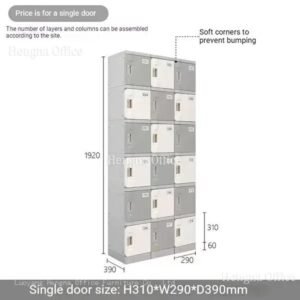
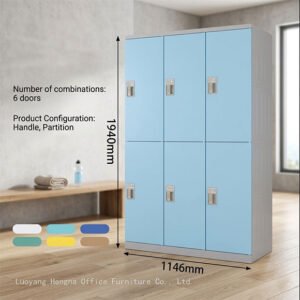
| Doors | 6 doors, 3 columns x 2 tiers | 6 staff per unit, standard change room layout |
| Compartments | Dual-zone per door: clean upper, dirty lower | Meets infection control clean/dirty separation protocols |
| Material | Antimicrobial high-impact ABS | Non-porous surface; inhibits bacterial growth |
| Surface | Smooth, joint-free, no paint | No crevices for bacteria; survives daily disinfection |
| Lock | Cam lock; RFID staff card lock optional | Integrates with hospital access control systems |
| Color | Light blue, white, or custom | Matches hospital interior design standards |
| Ventilation | Built-in door vents | Air circulation reduces moisture buildup |
The ABS material incorporates silver-ion antimicrobial agents that provide continuous protection between cleanings. Testing shows >99% reduction in bacterial counts within 24 hours (ISO 22196 certified). The antimicrobial properties are embedded in the polymer itself—not a surface coating—so they remain effective throughout the locker’s 15-20 year lifespan. Antimicrobial properties supplement but do not replace cleaning protocols; regular disinfection remains essential for infection control.
Surviving Hospital-Grade Disinfectants
Hospital cleaning protocols use strong disinfectants: quaternary ammonium compounds, hydrogen peroxide-based solutions, and bleach dilutions. Painted metal lockers develop surface etching from repeated exposure—the paint turns chalky, then peels.
ABS plastic is chemically resistant to all standard hospital disinfectants. Tested and approved for quaternary ammonium compounds, hydrogen peroxide (3-7%), sodium hypochlorite (1000-5000 ppm), isopropyl alcohol (70%), and phenolic disinfectants. Zero surface degradation after 1000+ cleaning cycles.
Daily cleaning: Wipe all surfaces with hospital-approved disinfectant. Focus on high-touch areas (door handles, lock mechanisms). No rinsing required.
Weekly deep cleaning: Enhanced disinfection of dirty zone compartments, ventilation slot cleaning, inspection for damage.

Cost Comparison
Steel lockers in hospitals need repainting, rust treatment, lock replacements, and general repairs every year—and hospital-grade disinfectants accelerate the damage. ABS lockers need only routine cleaning and occasional lock replacement.
Result: Roughly 60% lower total cost over 10 years for a typical 100-unit installation, with maintenance costs reduced to a fraction of steel annual upkeep.
Hospital Applications
Nursing staff change rooms: 6 staff per unit with clear clean/dirty separation. Secure storage for personal items, easy cleaning between shifts.
Operating theatre anterooms: Upper zone designated for sterile scrubs, sealed to prevent contamination from lower zone.
Emergency department: Quick-change capability between shifts, durability for high-traffic use, antimicrobial properties provide continuous protection.
ICU staff rooms: Dual-zone lockers support strict infection control protocols, antimicrobial surfaces provide additional protection layer.
Real-World Results
Teaching Hospital, Singapore: 150 units with RFID integration. After 3 years: zero paint degradation, infection control audit scores improved 35%, maintenance costs reduced 80%.
Regional Hospital, Australia: 200 units in tropical climate (80%+ humidity year-round). After 4 years: zero corrosion, all original lock mechanisms functioning, cleaning time reduced 60%.
Veterans Hospital, USA: 300 units with antimicrobial additives. After 5 years: zero repainting needed, surface remains smooth and cleanable, meaningful annual budget savings.
Common Questions
Is the antimicrobial additive certified for healthcare use?
Yes. ISO 22196 certified. Test reports available for infection control committee review. Testing shows >99.9% bacterial reduction against S. aureus, E. coli, P. aeruginosa, and Enterococcus.
Can the dual-zone compartments be configured differently?
Yes. Standard is upper-clean/lower-dirty. We can reverse this or provide equal-sized compartments. Custom configurations available for 50+ unit orders.
Do you supply RFID lock integration?
Yes. Pre-installed RFID readers work with standard hospital access control systems (HID, MIFARE, Legic). Staff use existing hospital ID badges. Benefits include audit trail, shift scheduling integration, and emergency override.
What is the warranty?
5-year warranty on locker body, 3-year on lock mechanisms, 2-year on electronic components. Antimicrobial properties guaranteed for locker lifespan. Expected lifespan: 15-20+ years.
Conclusion
Hospital staff change rooms require specialized storage that supports infection control protocols. Traditional metal lockers fail in healthcare environments due to paint degradation, rust, and bacterial harborage.
ABS plastic dual-zone lockers solve these problems with:
- Infection control: Non-porous, antimicrobial surfaces prevent bacterial colonization
- Clean/dirty separation: Dual-zone design meets healthcare workflow requirements
- Chemical resistance: Withstands hospital-grade disinfectants without degradation
- Durability: 15-20+ year lifespan with zero rust or paint failure
- Low maintenance: 80% reduction in maintenance costs vs. metal lockers
- Staff satisfaction: Clean, hygienic storage that healthcare workers trust
The dual-zone design supports the typical healthcare workflow: store street clothes in the clean zone, change into scrubs, work in patient care areas, return soiled scrubs to the dirty zone, shower, and change back. Physical separation prevents cross-contamination and reinforces proper hygiene practices.
For hospitals looking to improve infection control compliance while reducing maintenance costs, ABS plastic dual-zone lockers are the proven solution. Contact us for custom configuration, RFID integration, volume pricing, and installation support.