Wet Room ABS Lockers for Hostels and Hotels — 6 Doors That Handle Steam and Soaked Towels
Steam, shower splash, mop buckets, guests dripping wet at the locker door — hostel and hotel wet rooms destroy steel storage faster than almost any industrial site. The rust usually starts at the hinges and the feet, creeps across the door edges, and within two or three seasons the cabinet looks unfit for a guest-facing space. This guide explains what a wet room actually does to locker materials, why injection-molded ABS avoids that failure chain, and which specs matter when you order a six-door bank for a hostel or hotel project. Figures reflect Hengna’s 2026 ABS locker range.
What Steam and Soaked Towels Do to a Steel Locker
Constant humidity keeps bare steel damp for hours after every cleaning shift. Powder coating slows the damage down, but each hinge, foot and bolt hole is a coating break, and coating breaks are exactly where rust starts. One scratched door edge beside a shower becomes a rust streak down the front panel within weeks.
Soaked towels make it worse. Guests hang wet swimwear inside the compartment, so the inside stays humid overnight even when the room itself is dry. Vented steel doors help a little, yet moisture still condenses on raw metal night after night. Add chlorine-based floor cleaners to the routine and the feet of a steel cabinet corrode long before the doors do.
Wood and MDF lockers fail a different way: swelling. Once the laminate on a wooden door cracks, moisture enters the board and the edge swells for good. In a hostel, where luggage hits doors daily and cleaning never stops, that cycle repeats until the door no longer closes square.
What ABS Does Differently in a Wet Room
ABS lockers are injection molded as single panels, so there is no coating to chip and no bare edge to corrode. The material is waterproof through its full thickness — humidity, steam and chlorine-based cleaners sit on the surface and wipe off. Color runs through the panel rather than onto it, so a scratch never turns into a rust line, and staff can clean doors with ordinary soap and water.
Construction matters as much as material. Hengna’s ABS lockers use a mortise-and-tenon snap assembly with no screws and no glue. Fewer fasteners means fewer grime traps and fewer parts for a maintenance team to tighten. The molded design life exceeds 20 years, which is the figure hospitality buyers care about when they spread furniture cost across a decade of budgets.
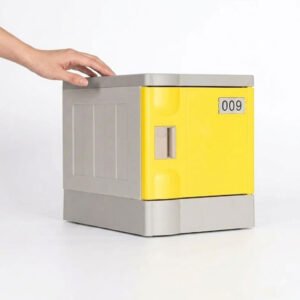
Rounded corners and smooth edges follow the same logic. In backpacker hostels, luggage strikes door edges every single day. ABS flexes and recovers where painted steel dents and exposes bare metal underneath.
The Six-Door Bank: Specs That Matter
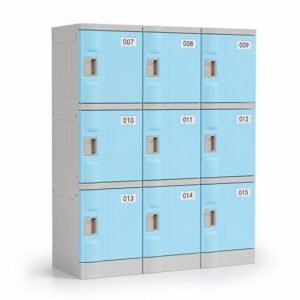
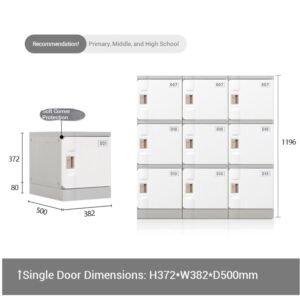
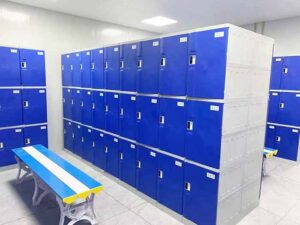
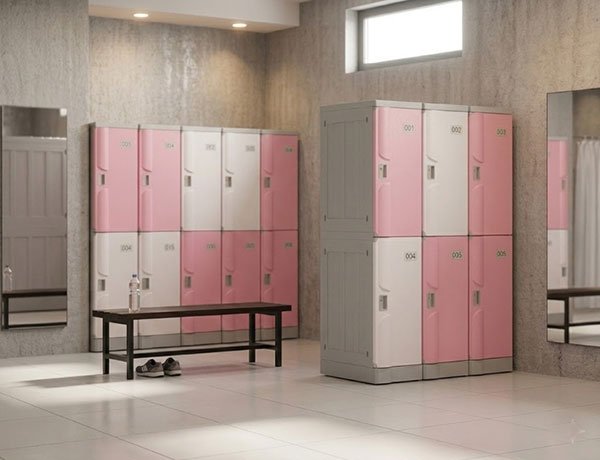
The six-door configuration is the workhorse for hostel and hotel wet rooms: three columns across, two tiers up. Each door module measures 930 × 382 × 500 mm, which gives an overall bank of 1940 × 1146 × 500 mm sitting on an 80 mm raised base. That footprint fits a standard changing alcove, and the two-tier height keeps every compartment within guest reach.
| Spec | Six-door bank (3 columns × 2 tiers) |
|---|---|
| Door module | 930 × 382 × 500 mm |
| Overall size | 1940 × 1146 × 500 mm |
| Base | 80 mm raised — feet stay out of mop water |
| Material | Virgin ABS, injection molded |
| Assembly | Mortise-tenon snap-fit, tool-free |
| Inside each door | Coat rod plus storage box |
| Lock options | Key, combination, RFID card |
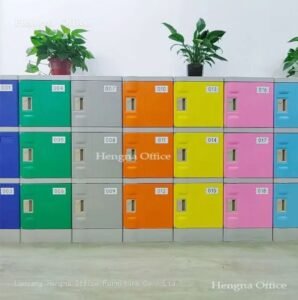
| Colors | 8 standard, custom on volume orders |
The module system behind it is the real flexibility. The same door family runs from 290 to 480 mm wide and 390 to 500 mm deep, in banks from 2 to 27 doors, with overall heights up to 2100 mm. A hotel can therefore match one visual line across full-height single-door columns in staff areas and six-door banks in guest changing rooms — same material, same color program, different division of space.
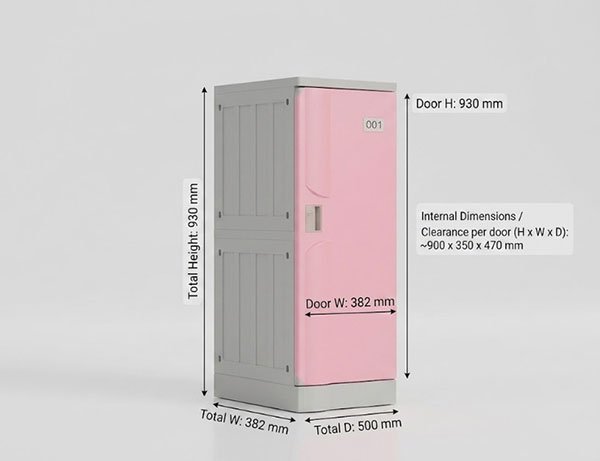
One module tells you almost everything: 382 mm wide, 500 mm deep, 930 mm tall. Three across and two tiers up, plus the 80 mm base, lands on the 1940 × 1146 × 500 mm six-door bank that most hostel wet rooms order.
How Hospitality Buyers Configure These
Bulk orders rarely come in one uniform block. A typical hostel specification mixes configurations so the room works for guests and staff at once:
- Guest changing rooms: six-door banks with combination locks, so there are no keys to lose and no rekeying when a code leaks.
- Long-stay rooms: full-height single-door columns with key locks for guests who want wardrobe space for a week, not a cubby for a night.
- Housekeeping and staff areas: RFID card locks tied to staff cards, keeping cleaning supplies separated from guest space.
- Zone identification: two or three of the 8 standard colors per floor — guests find their floor’s color faster than they read room numbers.
Sloping the order this way also spreads the budget. Staff areas take the cheaper key locks; guest-facing areas get the code or card options that reduce front-desk keys-in-a-draw problems.
Where ABS Is Not the Right Answer
An honest note, because no material suits every room. In a dry, carpeted office with stable HVAC, painted steel is cheaper and perfectly adequate — ABS earns its premium where water is present, not everywhere. ABS is also impact resistant rather than indestructible; for rooms with deliberate vandalism risk, raise the subject with the supplier before ordering. And in heritage properties where the interior calls for timber, wood-look laminate on steel often satisfies the designer while keeping the waterproof core. Choose by environment first, budget second.
Ordering From Hengna
Luoyang Hengna Office Furniture Co., Ltd. supplies the ABS locker range on a manufacturer-direct basis, with OEM and ODM support covering silk-screen logos, custom packaging and custom manuals for hospitality projects. Every order ships knock-down with foam protection and corner guards, so the banks arrive flat, pack tight and assemble on site without tools. Warranty is one year, and quotes come back within 24 hours.
Common Questions
What is the minimum order quantity?
MOQ depends on the configuration and color mix. Sample orders for a single wet room are accepted, and container quantities unlock better unit pricing. Send your floor plan and door count for an exact figure.
Can we put our hotel logo on the lockers?
Yes. Silk-screen logo printing, custom packaging and custom manuals are all supported on volume orders — the standard OEM package for hospitality buyers.
What is the lead time?
Lead time is confirmed in your proforma invoice and depends on order volume and season. Ask for the current schedule together with your quote so the delivery date lands before your renovation window.
How are the lockers packed for export?
Knock-down flat, wrapped in protective foam with corner guards, so more sets fit the container and nothing arrives chipped. Assembly on site needs no tools thanks to the snap-fit design.
FOB or CIF — how do you quote?
Both. Tell us your destination port and preferred terms, and the quote comes back within 24 hours on FOB or CIF basis, with the warranty and lock options spelled out line by line.