What Are the Advantages of ABS Plastic Lockers? Complete Guide for Facility Managers
Lockers are not merely basic amenities but critical factors influencing user experience, hygiene safety, and long-term operational costs. Lockers made from ABS (acrylonitrile butadiene styrene) engineering plastic have become the preferred choice in professional settings due to their proven performance. Here are the core advantages from material properties, functional design, and total cost of ownership.
High Strength and Full Environmental Tolerance
ABS is a high-performance thermoplastic that combines rigidity, toughness, and impact resistance. Its structure, formed by the copolymerization of acrylonitrile (chemical resistance), butadiene (impact strength), and styrene (rigidity), far surpasses ordinary plastics in stability.
Key material properties:
- Impact-resistant: Withstands drops, bumps, and daily abuse without denting
- Dimensionally stable: Maintains shape from -20°C to 80°C
- Chemically inert: Resists most acids, alkalis, and solvents
- Mechanically strong: Supports heavy loads without sagging
- UV-stabilized: Color stability for outdoor installations
- 60% lighter than steel: Easier handling, reduced hinge strain

Waterproof performance: Unlike metal lockers that rust or wood lockers that swell, ABS is inherently waterproof. Non-porous molecular structure prevents water absorption. Injection-molded construction eliminates seams. Water absorption rate: <0.5%. Can be installed directly in wet rooms, shower areas, and pool changing rooms. A water park in Florida installed ABS lockers 10 meters from the pool—after 5 years of constant splashing and 80%+ humidity: zero rust, no water damage, all doors operate smoothly.
Temperature adaptability: ABS performs reliably in cold environments (-20°C to 0°C, no brittleness or cracking), hot environments (30°C to 80°C, no softening or deformation), and humid environments (60-95% RH, zero moisture absorption, mold resistant). A swimming pool facility in Singapore (tropical climate, 30-35°C year-round, 85% humidity) and a ski resort in Switzerland (-10°C winter, heated to 20°C) both perform equally well after 4+ years. ABS lockers stay at ambient temperature—no cold shock when touching doors in winter, no condensation forming on surfaces.
Health, Safety, and Eco-Friendly
ABS material is non-toxic and odorless, free from formaldehyde, benzene compounds, and plasticizers. No paint coating means zero VOC emissions. Multiple international certifications (RoHS, SGS, REACH) confirm compliance with food contact and children’s product safety standards.
Antimicrobial options: Silver-ion technology embedded in polymer matrix provides continuous bacterial protection. ISO 22196 tested: >99.9% bacterial reduction within 24 hours. Effective against MRSA, E. coli, Salmonella. Used in hospital change rooms, food processing plants, and school locker rooms.
Sustainability: 15-20+ year lifespan reduces replacement waste. ABS can be recycled at end of life. Manufacturing scrap is recycled back into production. Lightweight construction reduces shipping emissions. No energy-intensive painting or coating processes. Lower embodied energy than steel or aluminum. Contributes to LEED and BREEAM green building credits. Meets green procurement requirements.
Modular Design for Flexible Configurations
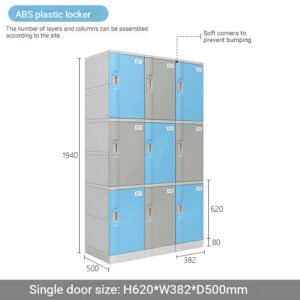
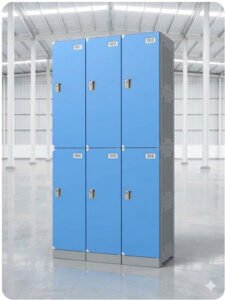
ABS lockers feature modular structures with snap-fit connections, supporting free combination of multiple specifications. Installation requires no welding or complex tools—two people can assemble a 6-door unit in 20-30 minutes.
Customization options: 8 standard colors plus custom Pantone matching (50+ units). Lock types include cam lock, padlock hasp, combination, RFID/electronic, and coin-operated. Accessories include interior shelves, shoe racks, ventilation fans, name plates, and logo printing. Specialized configurations include dual-zone compartments for healthcare clean/dirty separation, ventilated doors for wet gear drying, wide-body compartments for bulky equipment, and full-height units with hanging rods.
Application-specific designs: Swimming pools (enhanced ventilation, drainage holes, bright colors), schools (durable, graffiti-resistant, quiet operation), healthcare (antimicrobial, dual-zone clean/dirty separation, RFID integration), and industrial (heavy-duty, chemical-resistant, wide compartments for PPE). A university sports center expanded from 200 to 300 units over a weekend without closing the facility—new units matched existing lockers perfectly, installation took only 8 hours.
Low Maintenance, Long Lifespan
Unlike metal cabinets requiring periodic rustproofing or wood cabinets prone to moisture damage, ABS lockers are virtually maintenance-free. Colors are achieved through integral coloring—no paint to chip or peel.
10-Year Total Cost of Ownership
Steel lockers look cheaper at purchase, but the full 10-year picture includes annual maintenance (rust treatment, repainting, lock replacements, hinge repairs) plus at least one early replacement cycle in demanding environments. ABS lockers cost more upfront but need almost no maintenance and no replacement.
Result: About 60% lower total cost over 10 years for a typical installation, with annual maintenance savings that compound every year.
Enhanced User Experience and Safety

Safety features: 8mm rounded edges (vs. sharp metal corners) reduce injury risk. ABS doors close at 40-50 dB (vs. metal 70-80 dB)—40-50% quieter. 60% lighter than steel equivalents, easier to open and close, safer in seismic zones.
Hygiene: Non-porous surface prevents bacterial penetration. Easy to clean with standard disinfectants. No odor absorption. Resists mold and mildew growth. Daily wipe with damp cloth keeps lockers pristine. No special cleaning products or procedures required. Ideal for healthcare facilities (infection control), food processing plants (HACCP compliance), schools and gyms (odor and bacteria control), and public facilities (high-traffic hygiene).
Aesthetic longevity: Smooth, uniform surface without visible seams. Color stability prevents fading. No chipping, peeling, or rust stains. Professional appearance maintained year after year. Color runs through entire material—scratches don’t show exposed metal or primer. Attractive lockers improve facility perception, users take pride in personal storage space, and reduced vandalism follows from maintained appearance.
When to Choose ABS Plastic Lockers
Ideal applications: Swimming pools, water parks, aquatic centers. Hospitals, clinics, healthcare facilities. Schools, universities, boarding schools. Gyms, fitness centers, sports facilities. Food processing plants, commercial kitchens. Industrial facilities, laboratories. Any wet, humid, or corrosive environment.
Decision checklist:
- Wet, humid, or corrosive conditions? → ABS
- Want to minimize ongoing maintenance costs? → ABS
- Need 15+ year solution? → ABS
- Healthcare, food service, or school hygiene standards? → ABS
- Want quiet, safe, attractive lockers? → ABS
- Looking at 10-year total ownership cost? → ABS
When steel might be preferred: Dry, climate-controlled environments. Maximum security requirements (thicker steel). Extremely tight budgets (ABS costs 20-30% more upfront). Aesthetic preference for traditional metal look.
The advantages of ABS plastic lockers extend far beyond simple storage. With 63% lower total cost of ownership, 15-20+ year lifespan, zero rust or corrosion, superior hygiene performance, and enhanced user experience, ABS plastic lockers are the clear choice for modern facilities. Whether managing a swimming pool, hospital, school, gym, or industrial plant, ABS lockers provide the reliability, durability, and value that demanding environments require.
For facility managers evaluating locker options, the math is straightforward: ABS costs 20-30% more upfront but saves 63% over 10 years. The material does not rust, does not absorb moisture, does not require painting, and does not need replacement every 3-5 years. Add the hygiene benefits (non-porous, antimicrobial options, easy disinfection) and user experience advantages (quiet operation, rounded edges, modern appearance), and ABS becomes the default choice for any facility that values long-term performance over short-term savings.