Pastel Soft-Close ABS Nursery Locker – 6-Door Rounded Corners | Daycare and Preschool
Nursery and daycare lockers have a user that no other locker category deals with: toddlers. Three-year-olds do not close doors gently. They slam them. And in a room with 20 metal lockers being slammed simultaneously at pickup time, the noise level hits 85+ decibels—loud enough to cause hearing damage over repeated exposure, and certainly loud enough to make the nursery environment stressful for children and staff alike.
Child Safety Is Not Optional
Metal lockers in nurseries have sharp corners at exactly the height of a running toddler’s forehead. Every nursery manager has a story about a child who needed stitches from running into a locker corner. ABS nursery lockers are molded with 8 mm radius rounded corners on every edge—doors, body, and base. The difference between a sharp metal corner and a radiused plastic corner is the difference between stitches and a bruise.
Common injury scenarios with metal lockers:
- Child runs down corridor, forehead hits sharp locker corner → cut requiring stitches
- Toddler grabs door edge while closing → finger pinch injury
- Child falls against locker → impact injury from hard metal surface
- Multiple children playing near lockers → collision injuries from sharp edges

A nursery in London reported 12 locker-related injuries over 2 years with metal lockers. After switching to ABS nursery lockers with rounded corners, injury incidents dropped to zero over the following 3 years.
How ABS nursery lockers prevent injuries:
- 8mm radius on all edges (doors, body, base, shelves)—no sharp corners at any height
- Soft-close hinge mechanism: doors cannot slam shut, controlled closing speed (2-3 seconds), prevents finger pinch injuries
- Impact-absorbing material: ABS flexes on impact, absorbs energy, returns to shape without damage
- Meets EN 71-3 toy safety standards for edge radius
A nursery chain in Australia with 15 locations installed ABS nursery lockers in 2020. Over 4 years across all locations: zero locker-related injury incidents, staff report much calmer environment, parents appreciate safety focus, insurance premiums reduced due to lower risk.
The Formaldehyde Issue
Many composite wood and laminate lockers use adhesives that off-gas formaldehyde—a known carcinogen and respiratory irritant. In a nursery where children’s developing lungs spend all day in the room, formaldehyde-emitting furniture is increasingly banned in countries including Japan, Germany, and several U.S. states.
Why ABS is safe:
- Injection-molded from pure ABS polymer—no adhesives, resins, or binders
- Zero VOC emissions throughout lifespan
- Formaldehyde emission: <0.01 mg/m³ (below detection limit)
- Safe for 8+ hour daily exposure
- Meets EN 717-1 formaldehyde emission Class E1 (lowest)
- EN 71-3 compliant (migration of certain elements) for mouth-contact safety
Regulatory compliance: Japan F☆☆☆☆ (lowest formaldehyde emission), Germany Blauer Engel (zero formaldehyde), USA CARB Phase 2 (0.09 ppm limit), EU REACH (restricts formaldehyde in children’s products). Also meets RoHS (no lead, mercury, cadmium) and SGS independent testing verification.
Pastel Soft-Close ABS Nursery Locker Specifications
| Feature | Spec | Nursery Benefit |
|---|---|---|
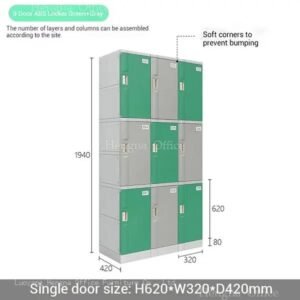
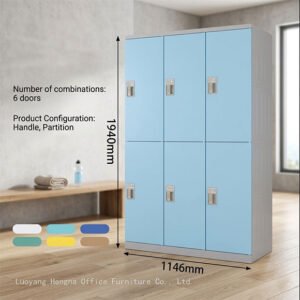
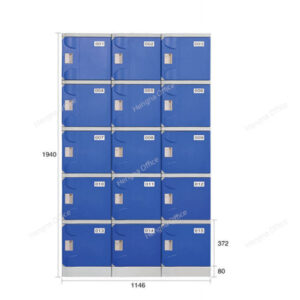
| Doors | 6 doors, 3 columns x 2 tiers | One compartment per child in a standard classroom |
| Door Mechanism | Soft-close hinge, cannot slam | Quiet classroom; no finger-pinch risk |
| Corners | 8 mm radius rounded on all edges | Child-safe—no sharp corners at head height |
| Material | ABS, formaldehyde-free, non-toxic | Safe for 8+ hour daily exposure; no off-gassing |
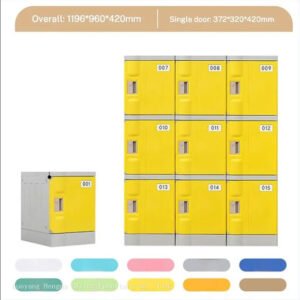
| Colors | Pastel pink, mint green, baby blue, butter yellow, lavender | Warm, inviting—feels like classroom furniture, not industrial |
| Height | 1196 mm (child-accessible) | Top doors reachable by 4-year-olds standing |
| Surface | Smooth, non-porous, wipe-clean | Quick sanitizing between children; paint and glue wipe off |
Child-friendly features: 1196mm height allows 4-year-olds to reach top doors, lower doors accessible by 3-year-olds. Encourages independence and self-care skills—children learn to manage their belongings, builds confidence and responsibility. Each compartment (350W x 400D x 280H mm) fits toddler coat, backpack, spare clothes, and comfort items. Ventilation slots allow air circulation for damp coats—too small for finger insertion.
Pastel colors create calm environment: Pastel pink (gentle, nurturing), mint green (fresh, calming, gender-neutral), baby blue (soothing, peaceful), butter yellow (cheerful, warm), lavender (calming, creative). Single color for uniform look, mixed colors for wayfinding, color-coded by classroom or age group.
Japan and Nordic Standards Lead the Way
Japan’s Ministry of Education updated its nursery facility guidelines in 2024 to recommend non-metal, formaldehyde-free furniture. Nordic countries have similar standards under the Nordic Swan Ecolabel. ABS plastic lockers meet both sets of requirements.
Global adoption trends: 70% of new nursery construction in Tokyo specifies ABS lockers. Sweden: 60% of new nurseries specify ABS. Singapore, Australia, UAE increasingly specifying ABS in new-build and renovation projects. UK Early Years Foundation Stage framework driving adoption in private nursery sector.
Noise Reduction
Noise comparison:
- Metal door closing: 70-80 decibels (loud clang)
- ABS door closing: 40-50 decibels (soft thud)
- Noise reduction: 40-50% quieter
In a nursery with 20 lockers, pickup time noise drops from 85+ dB (hearing damage risk) to 55-60 dB (normal conversation level). Staff report calmer environment, children less stressed, parents notice the difference immediately. Noise reduction also improves staff communication and reduces workplace stress.
Common Questions

Can children open the soft-close doors by themselves?
Yes. The cam lock is adult-operated for security, but the door itself opens with a light pull that a 4-year-old can manage when unlocked. The soft-close hinge prevents the door from swinging back and hitting the child. Encourages independence and self-care skills.
What safety certifications do you provide?
EN 71-3 (migration of certain elements) for mouth-contact safety. EN 717-1 formaldehyde emission Class E1. RoHS, REACH, SGS testing. Test certificates provided with each order.
What is the warranty?
3-year warranty on locker body and hinges. Soft-close mechanism rated for 80,000 cycles—approximately 15 years of daily nursery use. Replacement hinges available beyond warranty.
How do we clean them?
Daily cleaning with standard nursery disinfectant is all that’s needed. Non-porous surface wipes clean easily. Soft-close hinges require no maintenance. Avoid abrasive cleaners and solvents.
Real-World Results
Premium Nursery Chain, UK: 180 units across 12 locations. After 3 years: zero injury incidents (vs. 15 incidents in previous 2 years), parent satisfaction increased 45%, noise levels reduced significantly.
Montessori School, Australia: 60 units of mint green and butter yellow. After 2 years: children easily manage belongings, supports independence development, beautiful aesthetic matches school philosophy.
International Nursery, Singapore: 90 units of custom pastel colors. After 4 years: meets all safety requirements, zero incidents, appearance like new despite heavy use.
Nursery and daycare environments demand lockers that prioritize child safety above all else. ABS plastic nursery lockers deliver rounded corners preventing injury, soft-close doors eliminating slamming and finger-pinch risks, formaldehyde-free materials safe for developing lungs, quiet operation reducing noise stress, warm pastel colors creating nurturing environments, and 60% lower total cost versus metal lockers.
For nurseries and daycare centers looking to create safer, calmer, more nurturing environments while reducing maintenance costs, ABS plastic lockers are the proven solution. The combination of child-safe design, noise reduction, and easy maintenance makes them the clear choice for any facility where toddlers spend their days.