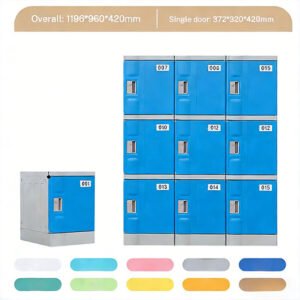
Full-Height Single-Door ABS Locker – 1940mm Hanging Rod | for Boarding School Kit
Laboratory locker rooms are chemically aggressive environments. Lab coats carry trace residues of solvents, acids, and reagents. The air in lab corridors often contains low-level chemical fumes from adjacent work areas. Standard steel lockers corrode from the inside out—the chemicals that lab coats bring into the compartment attack metal surfaces, paint, and lock mechanisms.
Why Steel Lockers Fail in Labs
Lab coats accumulate chemical residues through direct contact with splashes, aerosol deposition, and vapor absorption from volatile organic compounds. Even trace residues—not enough to be a safety hazard, but enough to be chemically active—transfer from coat fabric to locker interiors.
In a steel locker, these chemicals attack the paint first, then the metal. Within 12-18 months, lab lockers show rust along the bottom seam where heavier-than-air vapors settle, and around the lock mechanism where hands touch most often. Lock mechanisms gum up from chemical residues, keys break in corroded locks, and combination dials become stiff.
A pharmaceutical research lab in Boston reported steel lockers required replacement every 3-4 years. Lock mechanisms failed first, followed by door hinges, then structural corrosion at the base.
Why ABS Plastic Resists Laboratory Chemicals
ABS (Acrylonitrile Butadiene Styrene) is inherently resistant to most laboratory chemicals at ambient concentrations. It does not react with dilute acids, alcohols, ketones, or aldehydes at the trace levels found on lab coats. The same polymer family has been used for decades in laboratory equipment housings, fume hood panels, and chemical storage cabinets.

Chemical compatibility:
| Category | Examples | ABS Resistance |
|---|---|---|
| Dilute acids | HCl, H2SO4, HNO3 up to 10% | Excellent |
| Dilute bases | NaOH, KOH up to 10% | Excellent |
| Alcohols | Methanol, ethanol, isopropanol | Excellent |
| Aldehydes | Formaldehyde, acetaldehyde | Excellent |
| Saline solutions | Buffers, biological solutions | Excellent |
| Ketones | Acetone, MEK at low concentrations | Good |
| Esters | Ethyl acetate | Good |
Important: Lab coats carry trace residues, not bulk chemicals. Concentrations that transfer from fabric to locker surfaces are far below levels that would affect ABS.
Real-world validation: A chemistry department at a major university installed ABS lockers in their organic synthesis lab in 2019. After 5 years of daily exposure to acetone, ethyl acetate, dichloromethane, and various acids: zero chemical degradation, no discoloration, lock mechanisms operate smoothly. Adjacent steel lockers required replacement after 4 years.
Specifications
| Feature | Spec | Lab Benefit |
|---|---|---|
| Doors | 4 doors, single tier, wide body | Full-length hanging space for lab coats |
| Door Width | 480 mm per door | Fits bulky PPE: coat + safety glasses + respirator |
| Internal Rod | Stainless steel hanging rod | Hang coats without folding; corrosion-resistant |
| Material | Chemical-resistant ABS, injection molded | No reaction with trace solvents, acids, or sterilants |
| Surface | Smooth, non-porous, no paint | Easy decontamination wipe-down |
| Ventilation | Door louver vents | Passive airflow reduces chemical fume concentration |
| Color | White standard; grey, blue available | White makes contamination visible |
Wide-body compartments (480mm door width) accommodate bulky PPE with room for safety goggles, respirators, and gloves. Stainless steel hanging rod (25mm diameter) supports heavy coats without folding. Louver vents on each door allow passive airflow, reducing chemical fume accumulation inside compartments.
Where These Lockers Fit
University research labs: Chemistry departments (organic synthesis, analytical, biochemistry), engineering departments (materials science, environmental, chemical engineering). Withstands decades of student use with minimal maintenance.
Hospital pathology labs: Hematology, microbiology, histology, clinical chemistry. Supports infection control protocols, withstands hospital-grade disinfectants, durable for 24/7 operation.
Pharmaceutical QC labs: Raw material testing, finished product testing, stability testing, microbiology. GMP-compliant materials with documentation support for validation.
Industrial R&D labs: Chemical formulation, materials testing, process development, analytical services. Handles diverse chemical exposures with low maintenance for continuous operation.
Installation
ABS lockers ship ready to install—no painting, no chemical curing time, no off-gassing period. ABS is formaldehyde-free and emits no VOCs, important for laboratories monitoring air quality or operating under ISO cleanroom classifications.
Assembly: Two maintenance staff can assemble a 4-door unit in under 30 minutes with basic tools (Phillips screwdriver, adjustable wrench, level, rubber mallet). No special skills or training required. Printed instructions and video guide included.
Installation tips:
- Level surface required (±2mm over locker footprint)
- Anchor to floor for stability in high-traffic areas
- Leave 2-3mm gap between units for thermal expansion
- Position away from direct chemical exposure (fume hoods, spill zones)
- Ensure adequate ventilation around locker banks
Cleanroom compatibility: Suitable for ISO Class 7 (Class 10,000) and above. Low particle shedding compared to painted metal. For ISO Class 5 or stricter cleanrooms, stainless steel lockers recommended. Material certificates, outgassing test data, and cleaning validation protocols available on request.
Cost Comparison
Steel lockers in laboratories need lock repairs, rust treatment, hinge repairs, and repainting year after year—and chemical exposure shortens their life further. ABS lockers need only routine cleaning and occasional lock replacement.
Result: Roughly 60-70% lower total cost over 10 years for a typical installation, with maintenance costs reduced to a fraction of steel annual upkeep.

Common Questions
Which chemicals can damage ABS?
Concentrated strong acids (sulfuric, nitric above 30%), chlorinated solvents (dichloromethane, chloroform), and pure acetone will attack ABS at full concentration. These are not chemicals lab coats carry in trace amounts. For specialized labs handling these in bulk, we offer polycarbonate, polypropylene, or stainless steel alternatives.
Can lockers be used in cleanroom gowning areas?
Yes for ISO Class 7 and above. ABS is low-particle-shedding compared to painted metal. For ISO Class 5 or stricter, we recommend stainless steel. Material certificates, outgassing test data, and cleaning validation protocols available on request.
Can lockers be decontaminated after chemical exposure?
Yes. ABS’s non-porous surface allows complete removal of chemical residues. General protocol: remove visible contamination, wash with appropriate detergent, rinse, dry. For specific chemicals, we provide tailored decontamination protocols.
What warranty covers laboratory use?
5-year warranty covering material defects and chemical resistance under normal laboratory use with trace chemical exposure. Excludes damage from bulk chemical spills or exposure to incompatible chemicals.
Laboratory environments demand storage that withstands chemical exposure while protecting personnel items. ABS plastic chemical-resistant lab lockers deliver 15-20+ year lifespan, zero degradation from trace laboratory chemicals, and zero maintenance beyond routine cleaning.
The wide-body 4-door design accommodates bulky PPE with full-length hanging space. Stainless steel hanging rods resist corrosion. Louver vents reduce chemical fume accumulation. White surfaces make contamination visible for immediate cleaning.
For laboratories looking to reduce maintenance costs while improving safety and durability, ABS plastic lockers are the proven solution. The long-term cost savings compared to steel make the investment decision straightforward.
Contact us for chemical compatibility assessment, custom configurations, volume pricing, and installation support.