Why Are Factory Lockers Rusting Indoors? Humidity, Metal Dust, and the Coating Problem
Factory managers expect equipment to wear out. They budget for it. What they do not budget for is lockers ??indoor lockers, in a staff changing room with four walls and a roof ??rusting through in three years. It should not happen. But on factory floors across Southeast Asia, South Asia, and the Middle East, it happens all the time. The lockers are indoors. The environment is not. Here is what is actually going on.
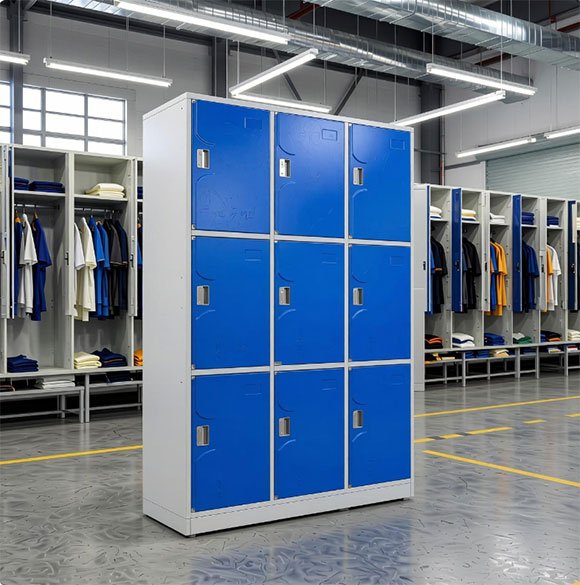
“But They Are Indoors” ??Why Indoor Rust Happens in Factories
The assumption is reasonable: lockers inside a building should not rust. The building has a roof. It is not raining inside. So why are the locker doors bubbling with rust after 18 months?
The answer is that factory changing rooms are not normal indoor spaces. They sit between two environments: the climate-controlled production floor and the unconditioned outside air. Workers move between these zones constantly, carrying heat, humidity, and airborne particulates with them. The locker room becomes a transition zone where temperature and humidity swing dramatically multiple times per shift. These swings create condensation. Condensation creates rust.
5 Factors That Make Factory Locker Rooms Rust Zones
- Humidity from showers and wet workwear. Factory workers in hot climates shower during or after shifts. The changing room humidity spikes every time the showers run. Wet workwear ??overalls, boots, gloves ??gets hung inside lockers. A factory changing room with 200 workers can maintain 85 percent relative humidity for 16 hours a day.
- Airborne metal dust. In factories with welding, grinding, cutting, or machining operations, microscopic metal particles are in the air ??on workers’ clothing, in their hair, on their boots. When workers change, these particles transfer to locker surfaces. Metal dust accelerates corrosion on steel surfaces through galvanic action: the dust particle and the locker steel create a tiny battery in the presence of moisture.
- Chemical residue on workwear. Workers in chemical, pharmaceutical, food processing, and automotive plants carry trace chemicals on their uniforms ??cutting fluids, solvent residues, cleaning agents. These residues off-gas inside the locker and settle on interior surfaces, chemically attacking the paint or powder coating.
- Temperature swings and condensation. A worker comes in from a hot production floor into an air-conditioned locker room. When the AC cycles off at night, the temperature rises. When it cycles on in the morning, surfaces cool below the dew point and condensation forms ??inside the locker, where no one sees it.
- Aggressive cleaning schedules. Factory locker rooms are cleaned with industrial-strength detergents and disinfectants. Daily exposure to these cleaners ??especially on the lower half of locker doors where mop splash is frequent ??breaks down the protective coating within 12 to 18 months.
The Coating Problem: Why Paint and Powder Coat Fail in Factories
Powder coating ??the standard finish on factory steel lockers ??is tougher than liquid paint but still vulnerable. It is applied as a dry powder and heat-cured into a continuous film. The problem is that this film is not truly continuous at the microscopic level. Pinholes, edge thinning around punched holes for locks and hinges, and micro-cracks from thermal expansion all create pathways for moisture to reach the steel underneath.
In a factory environment with metal dust, once moisture reaches the steel through any pinhole, the metal dust particles act as corrosion accelerators. What would be slow surface rust in a normal indoor room becomes aggressive pitting corrosion. A locker door that would last 8 years in a school corridor might last 2 years in an automotive parts factory.
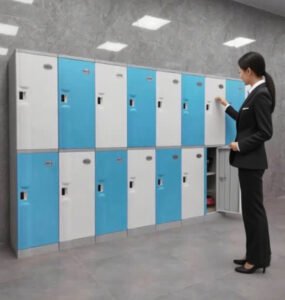
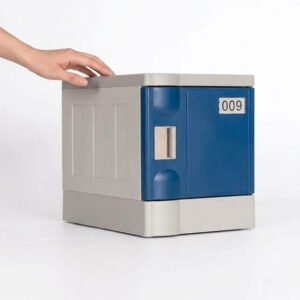
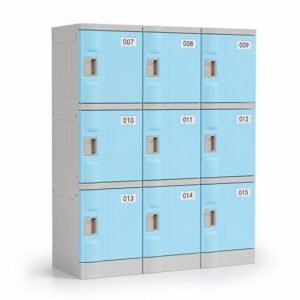
Why ABS Plastic Does Not Have These Failure Points
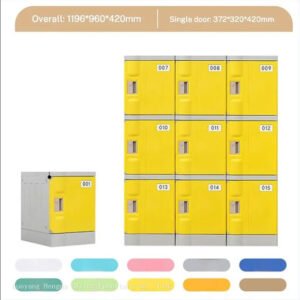
ABS plastic lockers eliminate all of the above failure mechanisms at the material level:
- No metal to rust ??the material is solid polymer throughout.
- No coating to fail ??color is integral, not applied as a surface layer.
- No galvanic reaction with metal dust ??ABS is an electrical insulator.
- Resistant to industrial cleaning chemicals ??ABS tolerates the detergents and disinfectants used in factory cleaning protocols.
- Built-in ventilation prevents internal condensation ??louvered door vents allow continuous passive airflow.
What a Major Auto Parts Manufacturer Found After Switching
An automotive parts plant in Southeast Asia replaced their steel lockers with fire-retardant ABS units across six workshop change rooms in 2024. The factory had previously been replacing 15 to 18 steel locker doors every year due to rust. Their environment: 32-degree ambient temperature, 75 percent average humidity, airborne metal dust from adjacent grinding and polishing stations.
After 18 months with ABS lockers: zero doors replaced, zero rust treatment required, and the daily cleaning routine reduced from a 45-minute wipe-down-and-spot-treat to a 15-minute wipe-down. The factory has since specified the same ABS lockers for their second plant, currently under construction.
How to Assess Your Factory’s Locker Corrosion Risk
A simple self-assessment for factory facility managers:
- Is your factory located within 50 km of a coastline? (Salt air doubles corrosion speed)
- Do workers shower on site, creating hot, humid conditions in the changing room?
- Do your production processes generate airborne particulates ??metal, chemical, or organic dust?
- Are your current lockers less than 5 years old but already showing rust spots?
- Does your cleaning protocol involve daily chemical spraying near locker surfaces?
Two or more “yes” answers mean your locker room is a high-corrosion environment. Standard painted steel lockers will fail early.
Frequently Asked Questions
Do ABS lockers meet factory fire safety requirements?
Standard ABS lockers meet general fire safety requirements for non-structural interior applications. For factories with heightened fire code ??welding areas, chemical storage zones ??UL 94 V-0 fire-retardant ABS lockers should be specified. These are self-extinguishing and meet the most stringent factory fire codes.
Can ABS lockers survive in a factory with welding nearby?
Yes, with the correct specification. For factory environments near welding, grinding, or hot-work zones, specify the fire-retardant (UL 94 V-0) ABS formulation. These have been deployed in automotive, metal fabrication, and chemical processing plants across Asia.
How do ABS locker prices compare to industrial steel lockers?
ABS lockers are priced comparably to heavy-duty industrial steel lockers. When the eliminated maintenance is factored in ??no rust treatment, no repainting, no door replacements ??the total cost of ownership favors ABS by a significant margin in any factory with the corrosion risk factors described above.