Locker Material Selection for Regulated Facilities: Cleanability, Particulates, and Compliance
Regulated facilities ?pharmaceutical plants, medical device manufacturers, food processing facilities, healthcare compounding areas ?impose requirements on ancillary equipment that general commercial specifications never address. A locker in a GMP-regulated changing room is not just furniture; it is a surface that must be compatible with validated cleaning protocols, must not generate particulate matter, and must not introduce contamination risk into the gowning workflow.
This guide maps specific regulatory requirements to locker material properties. It does not replace your quality system documentation; it identifies the material characteristics that make a locker compatible or incompatible with common regulated-environment requirements.
Requirement 1: Surface Cleanability
GMP guidelines for ancillary areas require surfaces that are smooth, impervious, and cleanable to a validated standard. The key word is “validated” ??the cleaning protocol must be documented, the cleaning agent and concentration must be specified, and the surface must be demonstrably compatible with that agent at that concentration.What this means for locker specification: A painted steel locker introduces a compatibility question that the locker manufacturer typically cannot answer: is this specific paint formulation compatible with this specific cleaning agent at this specific concentration after repeated exposure over years? Paint manufacturers test for general chemical resistance, not for compatibility with GMP-validated cleaning protocols. If the paint degrades over time ??softening, cracking, or delaminating ??the surface is no longer smooth and impervious, and the cleaning validation is no longer valid.Material-level solution: Solid-surface materials (ABS plastic, stainless steel, solid phenolic) eliminate the coating compatibility question because there is no coating to degrade. The cleaning agent contacts the same material every time, and the material’s chemical resistance is documented in its technical data sheet ??not inferred from a coating specification that may have changed between production batches. For regulated facilities, the documentation advantage of a single-material surface over a coated surface is significant: one material data sheet covers the entire cleaning compatibility question, and it does not change from batch to batch.
Requirement 2: Particulate Generation
Regulated facilities monitor airborne particulate counts. Any surface that generates particles ??through wear, degradation, or corrosion ??is a contamination source that must be identified and controlled in the facility’s environmental monitoring program. Lockers in changing rooms adjacent to production areas are within the contamination control envelope, even if the changing room itself is not classified.
What this means for locker specification: Painted steel lockers generate particles through two mechanisms: paint degradation (micro-flaking as the coating ages and loses adhesion) and rust formation (iron oxide particles that detach from corroded surfaces). Both mechanisms are progressive ??they increase over time as the locker ages. A new painted steel locker may generate negligible particles. The same locker at year five may be a measurable particulate source that shows up in environmental monitoring data.
Material-level solution: Materials that do not corrode and do not have a coating to degrade ??ABS plastic, solid phenolic, 316 stainless ??eliminate particulate generation from the locker body as a contamination source. Stainless steel can generate particles from metal-on-metal wear at hinges and lock mechanisms, so hardware specification matters separately from body material specification. ABS lockers with stainless steel hardware combine a non-corroding body with non-corroding moving parts.
Requirement 3: Cleaning Agent Compatibility
Regulated facilities use specific cleaning agents at validated concentrations. Common agents include quaternary ammonium compounds, hydrogen peroxide solutions (typically 3 to 7.5 percent), sodium hypochlorite solutions (typically 0.5 to 1 percent available chlorine), and isopropyl alcohol (70 percent). The locker material must withstand repeated exposure to whichever agent the facility’s cleaning protocol specifies ??not occasional contact, but daily or per-shift application over years of operation.Compatibility by material:
- ABS plastic: Compatible with quaternary ammonium compounds, hydrogen peroxide up to typical disinfecting concentrations, sodium hypochlorite at typical concentrations, and isopropyl alcohol. Not compatible with acetone, MEK, or strong organic solvents ??these should not be part of a locker cleaning protocol and are not typical GMP cleaning agents for ancillary surfaces.
- Powder-coated steel: Compatibility depends entirely on the coating chemistry. Polyester powders are generally resistant to quaternary ammonium and alcohol but may soften or discolor with repeated sodium hypochlorite exposure. Epoxy powders have better chemical resistance but poorer UV resistance. The problem is that the coating chemistry may differ between production batches, and the facility has no practical way to verify that the coating on delivered lockers matches the tested sample.
- Stainless steel (316): Compatible with all standard GMP cleaning agents. The limitation is that stainless is not immune to chloride-induced pitting over long exposure periods ??a consideration for facilities using sodium hypochlorite at the higher end of the concentration range in coastal locations.
Requirement 4: Workflow Integration ??Clean/Dirty Separation
Regulated facility changing rooms implement a clean/dirty workflow: street clothing is removed and stored in a “dirty” zone, facility garments are donned and stored in a “clean” zone, and personnel move directionally from dirty to clean. The lockers themselves must support this workflow through physical design ??separate compartments, color coding, or designated locker banks that make the clean/dirty boundary unambiguous.
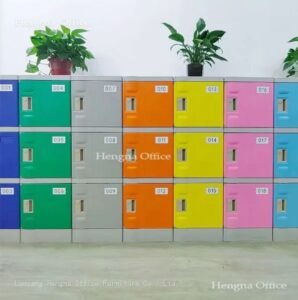
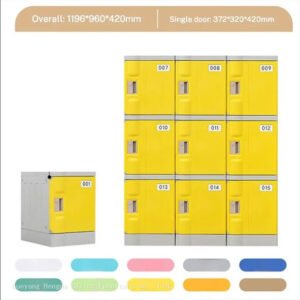
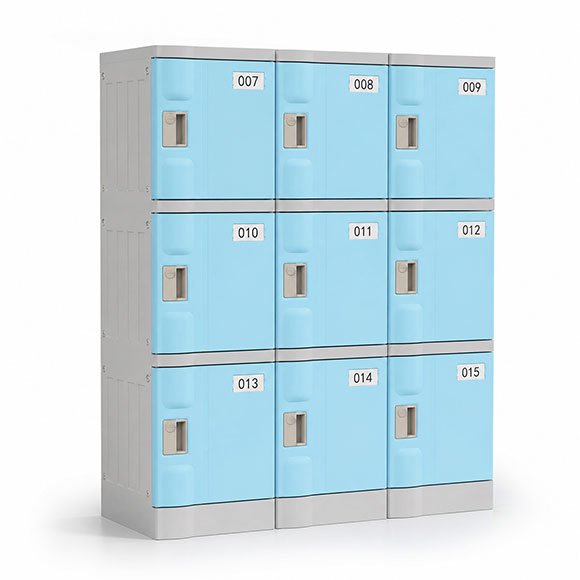
What this means for locker specification: The locker system must enable visual and physical separation of clean and dirty garments. This can be achieved through dual-compartment lockers (separate chambers for clean and dirty items), color-coded locker banks (one color for dirty-side lockers, another for clean-side), or physical separation (different rooms or zones). ABS locker systems offer an advantage in color-coded implementations because the color is through-body and does not wear off ??a blue dirty-side locker remains identifiably blue without repainting. Painted steel color coding requires repainting when the coating degrades, and during the period when paint is faded but not yet repainted, the color coding becomes ambiguous ??a compliance risk.
Requirement 5: Documentation and Audit Readiness
In a regulated facility, every surface that contacts product or personnel in the contamination control envelope is subject to audit. The auditor may ask: what is this surface made of, is it compatible with the cleaning protocol, does it generate particulates, and how do you know the answers to these questions?
What this means for locker specification: The locker supplier should be able to provide a material data sheet, a chemical resistance chart, and ??for coated products ??documentation of the coating chemistry and application process. For painted steel lockers, this documentation chain is longer: steel mill certificate ??surface preparation standard ??coating chemistry ??application process ??cure verification. Each link is a potential documentation gap that an auditor can probe. For solid-material lockers (ABS, stainless), the documentation chain is shorter: material certificate ??manufacturing process. Fewer links means fewer opportunities for a documentation gap.
Selection Summary: Matching Materials to Regulation Levels
- General manufacturing, no GMP: Standard materials are acceptable. Cleanability should be considered but formal validation is not required.
- GMP ancillary areas (changing rooms adjacent to classified production): Solid-surface materials recommended. The documentation and cleanability advantages over coated materials are significant for audit readiness, even though the changing room itself is not classified.
- Healthcare compounding, sterile preparation: Non-porous, non-particulate-generating materials required. Stainless steel or solid plastic. Coated materials present a particulate risk over time that is difficult to justify in a sterile preparation environment.
Frequently Asked Questions
Q: Does the locker material need to be included in the facility’s cleaning validation?
If the lockers are in an area covered by the cleaning validation protocol, then yes ??the cleaning agent must be demonstrated to be compatible with the locker surface and effective on the locker surface. For solid materials, this is documented via the material’s chemical resistance data. For coated materials, the coating manufacturer should provide chemical compatibility data for the specific cleaning agent at the validated concentration, and this data should be maintained as part of the validation support documentation.
Q: Are ABS lockers suitable for ISO-cleanroom classified areas?
Standard ABS lockers are designed for ancillary areas ??changing rooms, corridors, and support spaces ??not for classified cleanroom environments. For ISO 7 or cleaner environments, consult the locker manufacturer about cleanroom-specific models that may include sealed seams, reduced particulate shedding, and compatibility with cleanroom-grade disinfectants such as sporicidal agents. The material itself (ABS) is suitable; the question is whether the specific locker model is designed and assembled to cleanroom standards.