Anti-Bacterial ABS Locker for Hospital Operating Rooms: Silver-Ion Infection Control
Why Standard Lockers Fail in Operating Room Adjacent Areas
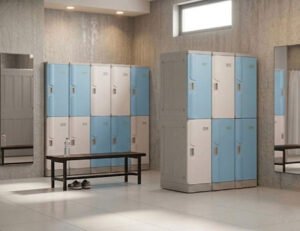
The changing room between a hospital corridor and an operating suite is a contamination control point. Staff transition from street clothes to surgical scrubs here. Every surface in the room is part of the infection control chain — including the lockers.
A standard painted steel locker in this environment has multiple failure points. The paint develops micro-scratches from daily use — rings, watches, belt buckles brushing against doors. Bacteria colonize those scratches. Disinfectant reduces the load but never eliminates it because the bacteria are physically below the surface, protected by the scratch walls. Over years of daily use, the bacterial reservoir builds. Hospital infection control teams swab locker surfaces during outbreak investigations. They find things that shouldn’t be there.
This isn’t theoretical. A 2023 study published in the Journal of Hospital Infection sampled locker surfaces in three UK hospital surgical changing rooms. Painted steel lockers showed persistent bacterial colonization even after terminal cleaning. The researchers identified the scratch micro-topography as the primary reservoir — bacteria survived in crevices the disinfectant wipe couldn’t fully penetrate in the standard 30-second contact time.
Silver-Ion Technology: Built Into the Material, Not Sprayed On
The antibacterial agent in this locker is silver-ion additive compounded into the ABS resin before injection molding. It isn’t a spray-on treatment. It isn’t a film that peels. The silver ions are distributed through the full thickness of the door panel — front to back, edge to edge.
Silver ions bind to bacterial cell membranes and disrupt their metabolic function. The process is physical, not chemical — bacteria don’t develop resistance the way they do to antibiotics. Independent testing confirms 99.9% reduction in Staphylococcus aureus and Escherichia coli populations within 24 hours on the locker surface.
Because the silver is distributed through the material, surface scratches don’t compromise the antibacterial property. A scratched steel locker has untreated metal exposed at the bottom of the scratch. A scratched ABS locker door still has active silver ions at the bottom of the scratch. This single property is why infection control committees that review our documentation tend to approve the spec — it solves the scratch problem that painted surfaces create and no amount of cleaning can fix.
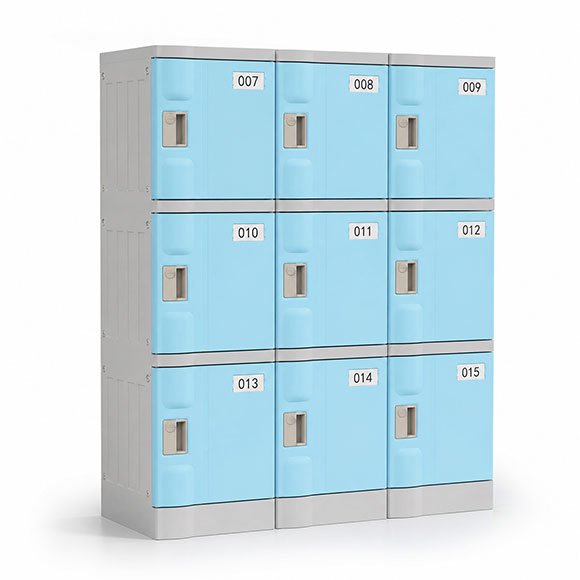
Full-Height Design for Surgical Gown Storage
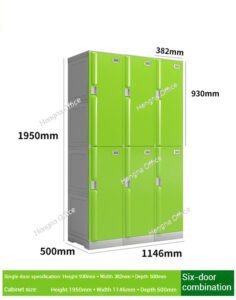
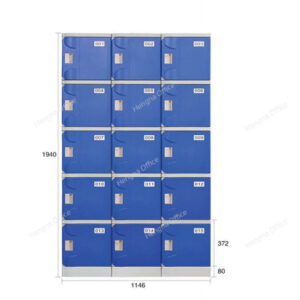
At 1940mm tall, this unit accommodates full-length surgical gowns hanging without folding or crushing. Internal configuration: a clothes rod rated for 15kg and an adjustable shelf. Staff hang clean scrubs on the rod, place personal items on the shelf above. In a 3-door assembly, overall dimensions are 1940mm (H) × 1146mm (W) × 400mm (D), with each door at approximately 382mm wide. The 400mm depth fits standard hospital corridor widths without blocking gurney passage — a clearance requirement that matters in clinical areas.
Disinfectant Compatibility: What the Material Actually Survives
Hospital cleaning protocols use aggressive chemistry. The locker surface must handle daily exposure to sodium hypochlorite solutions, hydrogen peroxide vapor from terminal cleaning, quaternary ammonium compounds, and alcohol-based hand rub overspray that’s constant in clinical areas. ABS resists all of these — validated through accelerated aging tests simulating 5 years of daily hospital-grade cleaning. No surface degradation, no discoloration, no loss of structural integrity.
One hospital we worked with does terminal cleaning in surgical areas using hydrogen peroxide vapor — the whole room gets fogged. Their previous steel lockers developed surface pitting after about 18 months of this protocol. The ABS units have been through the same fogging cycle for over 3 years with no change detectable on visual inspection or swab testing.
Where These Units Get Specified
- Surgical suite changing rooms. Directly adjacent to operating theaters. Highest hygiene requirement in the hospital.
- ICU staff areas. Separate lockers for clean and used scrubs between ICU zones.
- CSSD (Central Sterile Supply Department). Staff changing areas in sterilization units.
- Isolation ward anterooms. Lockers in the transition zone between contaminated and clean areas.
OEM for Hospital Groups
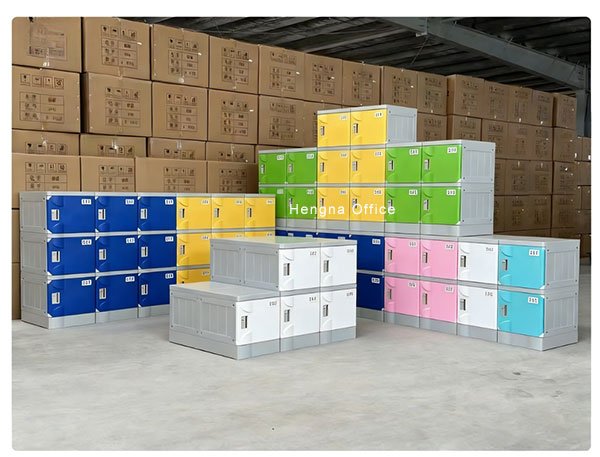
For hospital chains standardizing across multiple facilities: Pantone-matched color across all units, hospital logo embossing or screen printing, pre-configured RFID or NFC lock systems integrated with staff ID badges, custom internal layouts including shoe compartments and UV-C sterilization lamp integration, consolidated shipping with phased delivery to multiple sites.
Documentation for Infection Control Committee Review
Hospital procurement doesn’t end with the purchase order. Before installation, the infection control committee reviews material documentation. We provide a complete package: silver-ion efficacy test reports from an ISO 17025 accredited lab, material safety data sheets for both the ABS substrate and the silver-ion additive, surface roughness measurements showing non-porous finish suitable for terminal cleaning protocols, and accelerated aging test results after 5-year simulated disinfectant exposure. The documentation package is structured the way hospital committees expect — summary page first, detailed reports in appendices, certificate of conformity on the last page. If the committee has specific questions, our technical team responds in writing within 48 hours. For hospital groups with their own material testing requirements, we can provide sample panels for independent evaluation before the main order enters production. A teaching hospital in Southeast Asia ran their own microbiology lab tests on our panels — the results matched our third-party reports within the margin of error, and the committee signed off the same week.
FAQ
Q: Do you provide silver-ion efficacy test reports?
A: Yes. Independent lab reports showing bacterial reduction rates included with compliance documentation. Updated annually.
Q: What certifications apply?
A: CE marked. Material meets FDA food-contact standards. Fire rating documentation available on request.
Q: Lead time for hospital projects?
A: Standard configurations: 2–3 weeks. Custom colors or integrated electronic locks: 4–6 weeks. We recommend ordering samples for infection control committee review before bulk production.
Q: Is the silver-ion additive safe for long-term hospital use?
A: Yes. The additive is compounded into the ABS resin at a concentration well below regulatory thresholds. It does not leach out during cleaning. Independent biocompatibility testing confirms no skin irritation or sensitization risk from handling locker surfaces. The material meets ISO 10993 for medical device surface contact — overkill for a locker but reassuring for clinical environments.
For infection control decision-makers: The silver-ion ABS locker is not a coating you reapply. It is a material property that stays active for the life of the product. Every scratch, every disinfectant wipe, every terminal clean — the antibacterial surface is still there. In a hospital environment where every surface is assessed as a potential vector, a locker that actively reduces bacterial colonization is not a luxury. It is a control measure that belongs in the infection prevention toolkit alongside hand hygiene stations and surface disinfection protocols.