How to Select Locker Materials for Education Facilities: A 5-Factor Decision Framework
Education facility procurement follows a rhythm that commercial projects do not: everything must be ordered, delivered, and installed during a narrow summer window when buildings are empty. Get the material wrong, and the maintenance department inherits a problem that compounds every summer for the next decade. Get it right, and the lockers become background infrastructure ??always there, never requiring attention.
This framework organizes locker material selection around five factors that matter specifically for schools, colleges, and university athletic facilities. Each factor is weighted differently depending on whether you are outfitting a primary school hallway, a university pool changing room, or a dormitory common area.
Factor 1: The Maintenance Window Constraint
Education facilities have one reliable maintenance window per year: the summer break ??typically 8 to 12 weeks. Any locker maintenance that cannot be completed in that window bleeds into the academic term, which means lockers are unavailable while students are present. This constraint changes the economics of material selection in a way that purchase-price comparisons miss entirely.
Repainting steel lockers is a multi-week process: sanding, priming, painting, curing. A maintenance crew of three spending six weeks on locker repainting is 720 labor hours consumed ??and zero other building maintenance completed during that time. The cost is not just the paint and labor. The cost is the HVAC filter change that did not happen, the classroom technology upgrade that was deferred, the plumbing repair that waited another year.Scoring guidance: If your facility has a hard summer-window constraint and a backlog of deferred maintenance, materials that eliminate repainting cycles (solid-color plastics, stainless steel) should score higher than materials that require periodic recoating ??regardless of purchase price. The liberated summer labor has value that exceeds the material cost difference over a single repaint cycle.
Factor 2: User Age and Behavior
A primary school locker endures different forces than a university athletic locker. Younger students are harder on hardware ??doors are slammed, bags are yanked from hooks, lock mechanisms are operated with more force than necessary. The locker material needs to absorb this abuse without accumulating damage that compounds over years.
Steel lockers in primary schools accumulate dents. Each dent cracks paint, each paint crack starts rust. The first year’s dents become the third year’s rust spots. ABS lockers respond differently to impact: the material flexes and rebounds. A door slam that would leave a permanent crease in 0.8-millimeter steel is absorbed by the polymer structure and released. The door returns to its original shape. No dent means no paint crack, and no paint crack means no corrosion pathway.Scoring guidance: Facilities serving younger age groups or high-throughput environments (student recreation centers, gymnasiums) should weight impact resistance and damage accumulation higher than facilities serving older students or controlled-access areas. The question is not “will the lockers be abused” ?they will. The question is “does the abuse create permanent damage that triggers a secondary failure mode.”
Factor 3: Adjacent Environment
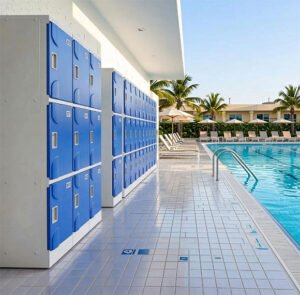
Not all lockers in an education facility face the same environment. A locker in an air-conditioned classroom hallway faces negligible humidity. A locker in a pool changing room faces continuous moisture. A locker in an outdoor corridor faces UV and rain. Treating all locker locations as equivalent during procurement is the most common error in education facility specification.
The practical solution is zone-based specification: different materials for different environmental zones within the same facility. The classroom hallway gets a different locker specification than the pool changing room, even if both are in the same building. This approach costs more in procurement complexity but less in maintenance over the facility’s life ??and the procurement complexity is a one-time cost, while the maintenance difference compounds annually.Scoring guidance: Map your facility by environmental zone before comparing materials. A material that is cost-effective in Zone A (dry, climate-controlled) may be the most expensive option in Zone C (wet, high-traffic) once maintenance costs are included. Zone-based procurement breaks the false choice between “cheap lockers everywhere” and “expensive lockers everywhere.”
Factor 4: Budget Structure ?Capital vs Operating
Education procurement often separates capital expenditure (buying lockers) from operating expenditure (maintaining them). This creates a structural incentive that works against lifecycle-cost thinking: the person approving the purchase order sees only the capital cost, while the person living with the maintenance cost has no say in the specification.
Breaking this deadlock requires data from your own facility. Pull three years of maintenance work orders related to existing lockers. Categorize them: repaint, door replacement, lock mechanism repair, rust treatment. Attach labor hours and material costs to each category. This single spreadsheet transforms a purchase-price comparison into a total-cost comparison ??and it uses data your facility already generates.Scoring guidance: Present the material comparison to the budget authority as a maintenance cost reduction proposal, not a locker purchase. The narrative is: “By spending X more on the initial purchase, we eliminate Y in annual maintenance costs, and the crossover point is year Z.” This framing matches how budget authorities evaluate capital requests ??they are looking for operating budget relief, not nicer lockers.
Factor 5: Future Flexibility
Lockers are fixed infrastructure, but the programs that use them change. A locker bank installed for a swimming program may need to serve a summer camp initiative five years later. A color-coded system designed for grade-level assignment may need to shift to team-based assignment. The locker material itself should not constrain these changes.
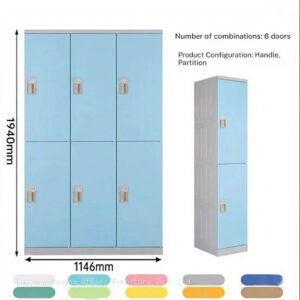
Modular locker systems ??where individual doors, body panels, and bases can be swapped independently ??provide more reconfiguration flexibility than welded monolithic units. ABS locker systems typically use modular assembly with mechanical fasteners, which means a damaged door can be replaced in minutes by in-house maintenance staff using basic tools. A welded steel locker with a damaged door often requires the entire column to be replaced because the door frame is integral to the locker body.Scoring guidance: Ask the supplier: if a single door is damaged, what is the replacement process, who can perform it, and what is the lead time? The answer reveals whether the locker is designed for repairability or designed for full-unit replacement. For education facilities where maintenance staff are generalists rather than metalworking specialists, module-level repairability is a significant operational advantage.
Scoring Summary: How to Apply the Framework
Rate each material option against the five factors on a 1-to-5 scale specific to your facility. There is no universal winner ??the right material for a dry primary school hallway is not necessarily the right material for a university aquatic center. The framework forces the evaluation to happen at the level of your specific facility rather than at the level of generic product categories.
The most common mistake in education facility procurement is evaluating lockers as a commodity ??”they are all lockers, get the cheapest ones that meet the spec.” This misses approximately 80 percent of the cost. The purchase price is visible; the maintenance cost is hidden but larger. A material selection framework that includes maintenance-window impact, user behavior, environment mapping, budget structure, and repairability surfaces those hidden costs before the purchase order is signed.
Frequently Asked Questions
Q: Should an entire school use the same locker material everywhere?
Not necessarily. Zone-based specification ?different materials for different environments within the same facility ?often produces better lifecycle economics than a single-material approach. The key is to document which zones get which material and why, so that future maintenance staff understand the reasoning behind the specification differences.
Q: How do I convince a budget committee to spend more upfront on lockers?
Bring your own facility’s maintenance data ??not a supplier’s sales presentation. A spreadsheet showing three years of actual locker maintenance costs, broken down by labor and materials, is more persuasive than any product comparison chart. Frame the request as a maintenance budget reduction measure with a specific payback timeline based on your facility’s own numbers. Budget committees respond to cost reduction proposals; they ignore product upgrade proposals.