Locker Materials in Coastal and High-Salinity Environments: A Technical Selection Guide
Coastal facilities face a locker corrosion problem that inland facilities do not: salt. Salt in the air, salt on surfaces, salt dissolved in the thin film of moisture that forms on every exposed surface in humid coastal air. This salt changes the corrosion equation in ways that standard locker specifications do not account for ??and the result is lockers that fail in half the expected time, even when they are installed indoors and never directly exposed to seawater.
This guide explains how salt-accelerated corrosion works, which materials resist it, and what design features matter specifically for coastal installations. The guidance applies to any facility within roughly 5 kilometers of a coastline ??the zone where airborne chloride deposition significantly exceeds inland background levels.
The Salt Corrosion Mechanism: Why Coastal Air Is Different
Normal atmospheric corrosion of steel requires three things: water, oxygen, and an electrolyte to conduct ions between the anodic and cathodic areas on the metal surface. In inland environments, the electrolyte is typically just water with trace dissolved minerals ??a weak conductor. Corrosion proceeds slowly because the electrochemical circuit has high resistance.
In coastal air, chloride ions from sea salt dissolve into the moisture film on metal surfaces. Chloride is a powerful electrolyte ??it dramatically reduces the electrical resistance of the water film, which accelerates the corrosion current between anodic and cathodic regions. The result is that steel in coastal air corrodes 3 to 8 times faster than the same steel in inland air, depending on distance from the shoreline, prevailing wind direction, and ambient humidity.
A critical detail that affects locker specification: this corrosion occurs on surfaces that never get wet from rain or splashing. The moisture film is invisible ??it forms from ambient humidity alone when relative humidity exceeds roughly 60 percent. Coastal facilities above this humidity threshold are corroding continuously, 24 hours a day, even when the lockers appear completely dry.
Why Paint-Based Protection Underperforms in Coastal Zones
Paint protects steel by being a barrier. In a coastal environment, the barrier faces a relentless chemical attack. Chloride ions are small enough to permeate most polymer coatings at the molecular level ??not through visible cracks or pinholes, but through the microscopic free volume that exists in all polymer networks. Over months of exposure, chloride concentration builds up at the coating-steel interface.
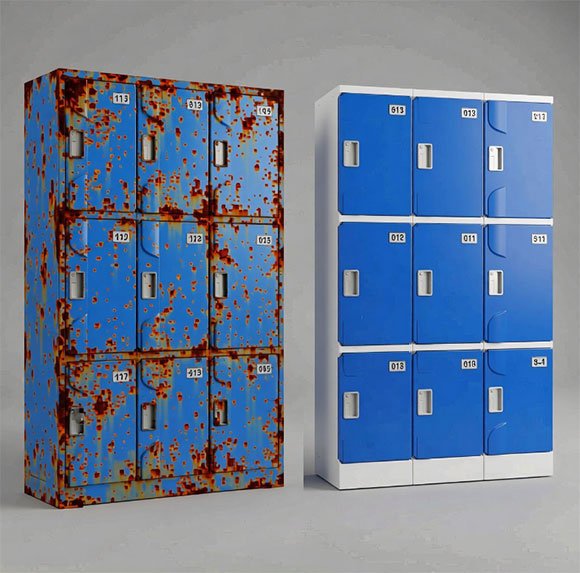
Once chloride ions reach the steel surface beneath the coating, they initiate a corrosion cell that operates beneath intact paint. The corrosion products (iron oxides) occupy more volume than the steel they replace, generating mechanical stress that eventually blisters or cracks the coating from below. By the time rust is visible, the corrosion has been active for months and has spread laterally beneath the coating far beyond the visible spot.
This is why coastal facilities report that repainted lockers re-rust faster than original lockers. The repaint process rarely removes all chloride contamination from the steel surface. The new coating goes on over a surface that already has chloride embedded in micro-pits ??and the corrosion restarts immediately, now with a fresh coating to hide beneath.
Material Options: Ranked by Coastal Corrosion Resistance
- Standard powder-coated steel: Not recommended within 5 km of coastline. Coating failure typically visible within 18 to 30 months. Once initiated, corrosion spreads faster than inland due to continuous chloride supply.
- Marine-grade epoxy-coated steel: Better than standard powder coating ??epoxy resins have lower chloride permeability. Extends visible failure to 3 to 5 years. Does not eliminate the underlying mechanism; it just slows the chloride permeation rate.
- Galvanized steel with topcoat (duplex system): The zinc layer provides sacrificial protection ??zinc corrodes preferentially, protecting the steel until the zinc is consumed. Effective in coastal environments if the zinc layer is thick enough (minimum 85 microns or 600 g/m?). The topcoat protects the zinc from rapid consumption. Failure mode: once the zinc layer is locally exhausted, steel corrosion initiates at that point.
- 316-grade stainless steel: Excellent corrosion resistance in coastal environments. The molybdenum addition in 316 provides chloride resistance that 304-grade lacks. Limitations: high material cost, high weight, and susceptibility to crevice corrosion in stagnant conditions (tight joints, under gaskets) where chloride can concentrate.
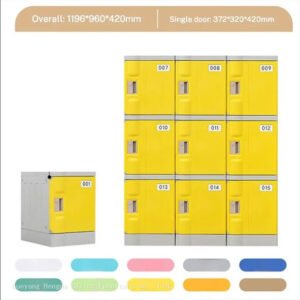
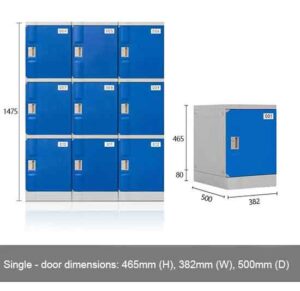
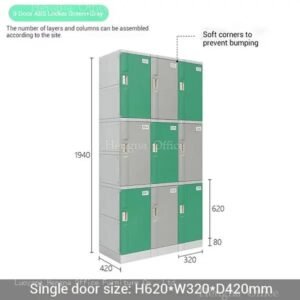
- ABS plastic: Immune to chloride-induced corrosion because the material contains no metal. Chloride deposits on the surface can be removed by routine cleaning with no cumulative effect on the material. No coating means no chloride permeation pathway. The limitation is material stiffness ??ABS lockers are lighter than steel, which is an advantage for installation but means they require proper anchoring for stability in high-traffic areas.
Design Features That Matter Specifically for Coastal Installations
Hardware material: Hinges, lock plates, handles, and fasteners should be 316 stainless steel. Standard zinc-plated hardware will corrode in coastal air faster than the locker body ??and seized lock mechanisms are more significant than cosmetic rust because they make the locker unusable. The hardware is the weakest link in any coastal locker installation; specify it to a higher standard than the locker body.
Ventilation: Coastal air is humid, and a closed locker creates a stagnant humidity pocket. Ventilation louvers or gaps allow air exchange that reduces the duration of high-humidity conditions inside the locker after each use. This is important for any locker material because it affects drying time, but it is critical for coated metal lockers because every hour of internal humidity above 60 percent is an hour of active corrosion.
Base clearance: A raised base or leg system lifts the locker body above floor level. This serves two purposes in coastal facilities: it prevents the locker from sitting in standing water during floor cleaning, and it creates an air gap that allows the bottom of the locker ??the area most vulnerable to corrosion because coatings are thinnest there ??to dry between cleaning cycles. Base clearance of at least 50 millimeters is recommended for coastal installations.
Maintenance Protocol Differences: Coastal vs Inland
Coastal facilities should adjust their locker maintenance protocol in two ways that inland facilities typically do not need:
- De-salting wash: A quarterly freshwater rinse of locker exteriors ??not a cleaning, just a rinse ??removes accumulated chloride deposits before they have time to permeate coatings or initiate corrosion. This is a preventive protocol that costs almost nothing and can extend coating life measurably. Facilities within 500 meters of the shoreline benefit from monthly rinses during the humid season.
- Inspection frequency: Coastal locker inspections should be quarterly rather than annual. The accelerated corrosion timeline means that rust detected in an annual inspection may have been active for 8 to 10 months ??by which point mechanical removal is more extensive. Quarterly inspections catch corrosion at an earlier stage when remediation is simpler and less invasive.
Frequently Asked Questions
Q: How far inland does salt-spray corrosion matter for locker specification?
Chloride deposition decreases roughly exponentially with distance from the shoreline. Within 500 meters: severe exposure, all metal lockers should be 316 stainless or non-metallic. 500 meters to 2 kilometers: moderate exposure, coated steel will have a reduced service life. 2 to 5 kilometers: mild exposure, accelerated compared to inland but manageable with good coating specification and maintenance. Beyond 5 kilometers: effectively inland conditions unless there are local salt sources (de-icing salt storage, industrial emissions).
Q: Can dehumidification solve the coastal locker corrosion problem?
Dehumidification reduces corrosion rate by reducing the time that surfaces are above the critical humidity threshold for chloride-activated corrosion (approximately 50 to 60 percent relative humidity). It helps, but it is a building-level solution that consumes energy continuously and only works if the locker room is sealed from the outside environment ??which is often not the case in naturally ventilated coastal buildings. Dehumidification extends coating life; it does not eliminate the underlying corrosion mechanism.