Why Workshops Are Replacing Steel Cabinets — A Factory Manager’s Look at ABS Plastic Lockers
If you’ve walked through a factory changing room recently, you’ve probably seen it: steel lockers with rust eating up from the bottom corners, door hinges that squeak louder than the production line, and corners dented from a forklift bump two years ago that nobody bothered to fix.
It’s not that steel lockers are poorly made. It’s that factories are horrible environments for them. Humidity from floor cleaning. Cutting fluid mist in the air. The occasional welding spark or chemical splash. A steel cabinet in a workshop isn’t a storage solution — it’s a rust project waiting to happen.
We’re Luoyang Hengna Office Furniture Co., Ltd. We’ve been supplying office and storage furniture for export since 2017. Over the last 3 years, more than half of our ABS locker inquiries come from factories. These customers aren’t replacing broken lockers — they’re replacing the concept of what a workable locker is supposed to be.
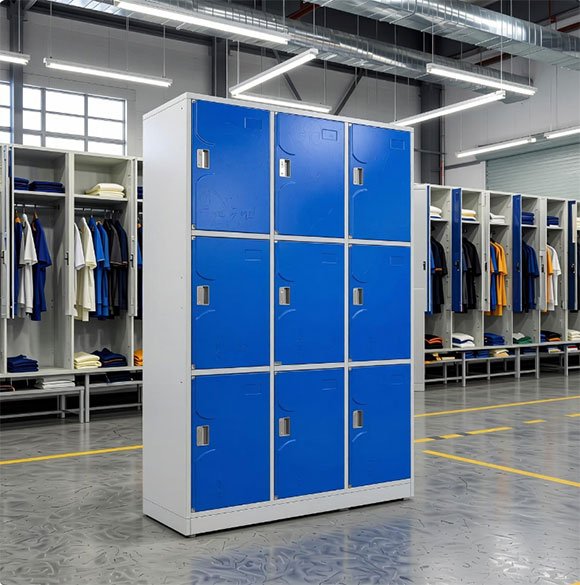
Why Workshops Are Replacing Steel Cabinets|Steel vs ABS: what actually fails first
Let’s be specific, not abstract.
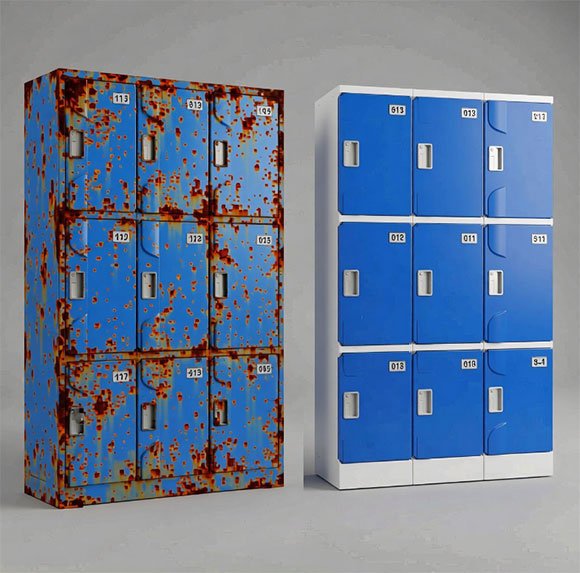
In a typical tool-and-die workshop, steel lockers fail from the bottom up. The base panel sits on the floor. Factory floors get cleaned — sometimes twice a shift in food or chemical plants. Water pools, seeps under the panel gap. Within 6 months, rust bubbles form. By year 2, the bottom 10cm is compromised. By year 3, the cabinet leans.
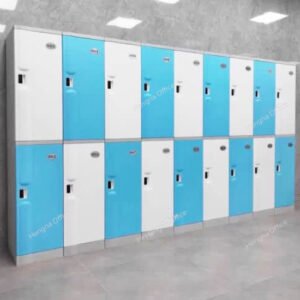
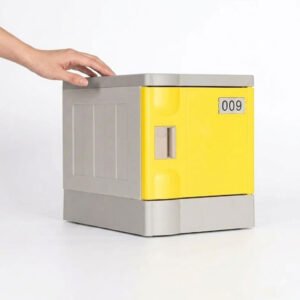
ABS lockers sit on an 80mm raised base. That’s not a design quirk — it’s clearance for mop water. The base is molded as one piece with the cabinet frame, no joint for moisture to creep into. It’s a dead simple solution, but you’d be surprised how many factory procurement teams don’t evaluate this until they’ve already bought the wrong thing.
Then there’s impact damage. A forklift in a warehouse aisle has about 3cm of clearance tolerance in either direction. One stray nudge into a steel cabinet — the panel dents, the door frame twists, the latch doesn’t line up anymore.
ABS plastic is different. It flexes on impact instead of deforming. You nudge it, it bounces back. We’ve had clients send photos of cabinets in use for 4+ years in busy workshops — the surface has micro-scratches, sure, but the structure is intact.
What 4 years of factory use actually looks like
Here’s what we hear from installs that have been running for a while — not from brochures, from actual factory floors:
- Surface condition: ABS keeps its color. No peeling, no rust bleeding through. Slight dulling on the most-touched areas, same as any plastic product left in a dusty room. A wipedown with a rag fixes 90% of it.
- Door operation: The hinge is a concealed circular pivot, not an exposed pin. No screws to work loose. Same smooth open-close as year one — the biggest surprise for factory managers who expected them to sag.
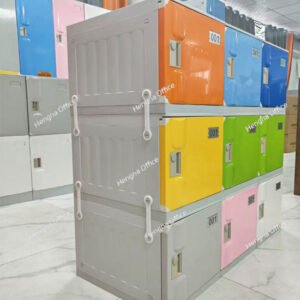
- Structural stability: The cabinet uses mortise-and-tenon joints (榫卯), interlocking pieces that slot together. No bolts, no welding. When one panel takes a hit, the force doesn’t concentrate at a single screw point — it distributes across the joint. Result: no localized failure.
The one thing that DOES show age is the lock hole area if employees are rough with padlocks day after day — but that’s user behavior, not material failure. We recommend a recessed lock plate for factories with shift workers, which deals with it.
Lock choice matters more than most think
Most locker discussions skip this part, but in a factory, the lock IS the daily interaction point.
| Lock Type | Best For | Not Ideal For |
|---|---|---|
| Standard hasp + padlock | Fixed-shift workers with their own locks | Shared lockers, shift rotations |
| Key card / RFID lock | Multi-shift shared cabinets | Dirty environments (grease on cards) |
| Combination code lock | No-key convenience, any user | Forgetful users (reset = admin headache) |
For a factory with 3 rotating shifts and shared locker spots, RFID makes sense — swipe in, swipe out, admin manages everything from one panel. For a single-shift machine shop where each worker owns their locker long-term, a padlock hasp is simpler and cheaper. There’s no “best” lock — there’s the right lock for the workflow.
2026 model: what’s in a Hengna ABS locker order
Current spec (2026):
| Spec | Value |
|---|---|
| Material | Virgin ABS engineering plastic, injection-molded |
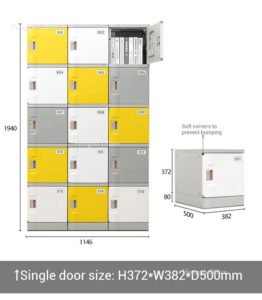
| Door count | 3 / 6 / 9 / 12 / 15 / 18 / 27 |
| Individual compartment | 382mm (W) × 500mm (D) × 620mm (H) for 9-door model |
| Base height | 80mm (moisture clearance) |
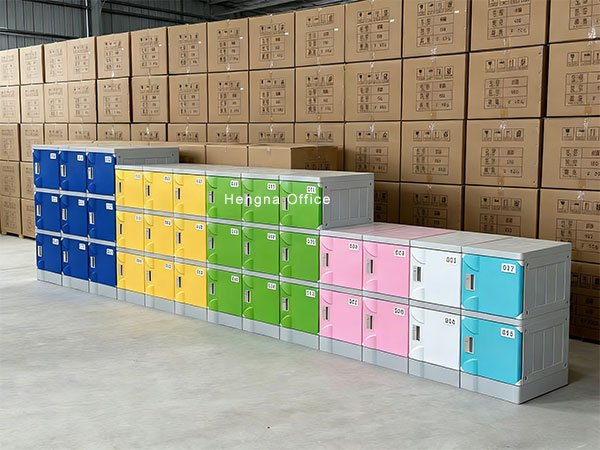
| Standard colors | 8: deep blue, yellow, light blue, light green, orange, pink, white, grey |
| Wood grain finish | Available (custom order) |
| Design life | 20+ years |
| Assembly | Mortise-and-tenon, tool-free |
| Certification | CE |
We stock 9-door as the most popular — one per 10-person workshop bay, fits work uniforms, helmet, and boots without cramming.
Questions factory buyers ask (short version)
“Can you do our brand on it?”
Yes. Silk-screen logo on doors, custom packaging with your branding. We’ve done it for European and Southeast Asian clients.
“How long from order to ship?”
Standard colors in stock: 15-20 days. Custom colors or non-standard door counts: add 10 days. FOB Qingdao/Tianjin/Shanghai.
“What if something breaks?”
1-year warranty. Spare parts shipped with the container. Send us a photo of any issue, we respond same day with a solution.
“Can you mix door counts in one container?”
Yes. We frequently pack 3-4 models in one shipment. The 20ft container holds roughly 80-120 units depending on configuration.
About us
Luoyang Hengna Office Furniture Co., Ltd. — 9 years in office and storage furniture export. CE certified. We work with stable production partners in China’s furniture manufacturing cluster. What you see on our spec sheet is what we’ve actually shipped — not catalog vaporware.
Contact us with your door count, color preference, and lock type. Quote back within 24 hours.