Formaldehyde Free School Locker: ABS Material Compliance for EU Education Projects
The Regulation That Changed School Locker Procurement
France updated its indoor air quality monitoring for schools in 2023. Belgium and the Netherlands tightened VOC limits for education furniture. Germany’s AgBB scheme already requires formaldehyde emission testing for building products used in classrooms.
The result: painted steel lockers passed. Laminated wood lockers with urea-formaldehyde resin didn’t. And “all-steel” lockers that use composite panels for internal dividers? Many failed too — the outer shell was steel, but nobody checked the back panel.
For a school procurement officer in Europe, this shifts the checklist from “steel vs wood” to “which material won’t fail the air quality test after installation.” ABS plastic enters at exactly this point — not because it costs less, but because it has no formaldehyde to test for.
Where Formaldehyde Actually Comes From
It’s not in the metal. It’s not in the plastic. It’s in the composite — MDF, particle board, plywood — bonded with urea-formaldehyde resin. These boards show up as back panels, shelves, and internal dividers inside locker cabinets, then get painted over.
A Q1 2025 spot check by a Dutch education procurement agency found that 6 of 10 “steel locker” samples contained composite internal panels with formaldehyde levels exceeding EN 16516 limits. The sales sheet said “steel.” The internal structure said otherwise.
This is also why old school locker rooms sometimes have that “new furniture smell” years after installation. Formaldehyde off-gassing from composite panels doesn’t stop. It slows down over time but never hits zero. In a poorly ventilated school corridor, that’s a low-grade exposure that repeats every day a student opens their locker.
| Material | Formaldehyde Source | Regulatory Risk |
|---|---|---|
| ABS plastic | None — injection molded, no resin | Passes all EU indoor air standards |
| Steel (with composite internals) | Urea-formaldehyde in MDF back panels | May fail EN 16516 |
| Laminated wood | Binder resin throughout the board | High — off-gasses for years |
Why ABS Has No Formaldehyde Problem
ABS (acrylonitrile butadiene styrene) is a thermoplastic. Production: plastic granules are melted and injected into a mold. The shape forms in seconds as the material cools. No glue. No bonding agent. No resin of any kind.
Third-party lab reports on Hengna ABS locker panels show formaldehyde below 0.01mg/m³ — the detection floor. Lead, cadmium, and mercury also below detection limits. These results are material properties, not batch achievements. Every panel comes out of the same mold with the same chemistry.
Beyond Formaldehyde: What Else Matters for Schools
Formaldehyde gets the headlines. But for a school locker room, the full picture includes:
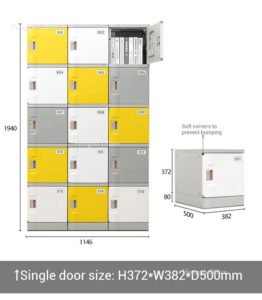
- Sharp edges. A child running in a corridor — steel locker corner at head height is a documented injury risk. ABS doors and frames have radiused edges throughout. Some schools specify this in tender documents now.
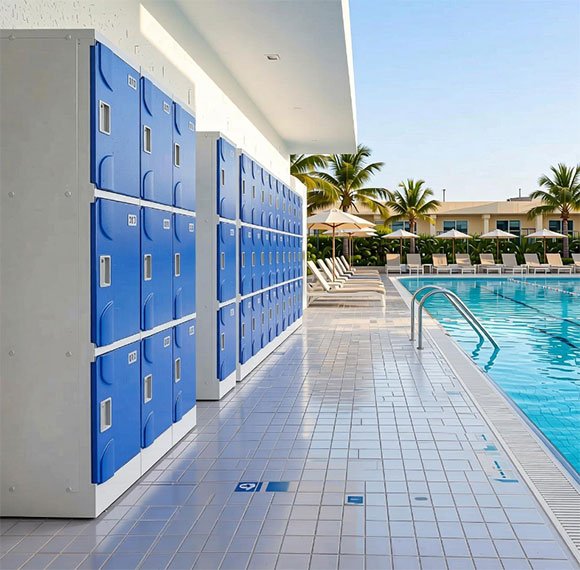
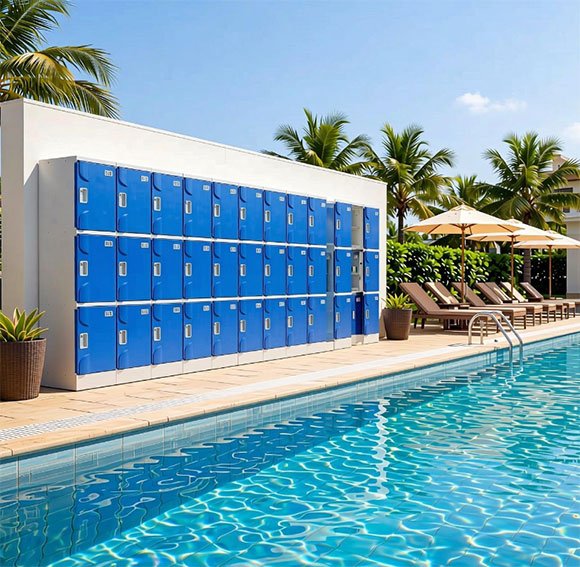
- Rust in changing rooms. After a school builds a new sports hall, the changing room lockers face daily humidity from showers. Steel rusts at the bottom edge in 18–24 months. ABS doesn’t rust.
- Color retention. School lockers get kicked, scraped with bags, and cleaned with whatever disinfectant is available. On painted steel, this adds up to chipping. On ABS, the color is the material itself — a scratch stays the same color.
Modular Setup for Changing Enrollment
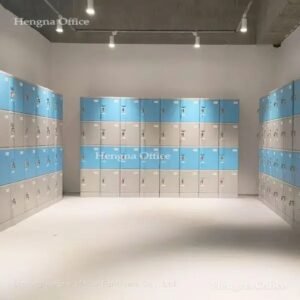
Schools don’t have static populations. One year a grade level has three classes. The next year, four. ABS locker panels configure into 3, 6, 9, or 12 door units using the same base components. Adding a column means ordering more doors and panels — not replacing the whole system.
Lock types can be mixed within a single installation: combination locks for younger students who lose keys, padlock hasps for older students who prefer their own, electronic locks for staff areas.
Compliance Documentation We Provide
- Third-party formaldehyde and VOC test reports (ISO 16000 / EN 16516)
- CE declaration of conformity
- Material safety data sheet (MSDS) for ABS panels
- Fire rating documentation (EN 13501 classification)
- Assembly instructions with torque specs and wall anchoring requirements
Nordic and Western European school tenders typically require this documentation before approving a supplier. We include it with the quotation — not as a separate paid service. If the tender form has a specific format for test reports, we fill it in. We’ve done this enough times to know what a school procurement committee asks for in round two of review.
Installation in Existing School Buildings
Most school locker replacements happen during summer break — a 6–8 week window to remove old units, prep the space, and install new ones. Snap-fit ABS assembly shines here. No welding means no fire permits. No wet paint means no off-gassing or curing time. Two maintenance staff can assemble a 6-column installation in a single day. The school opens in September with lockers that don’t smell like a chemistry lab. For renovations where the old locker room footprint stays the same, we can match column widths to the existing layout so no flooring or wall work is needed. Existing plumbing and electrical pass right through — nothing to relocate. One school district in Belgium timed their replacement during the July shutdown. Old steel lockers out on Monday, ABS columns assembled by Wednesday afternoon, hallway painted on Thursday, ready for inspection Friday morning. The contractor told us they had never finished a locker job ahead of schedule before.
FAQ
Q: Do you have project references in Europe?
A: Yes. ABS lockers supplied to schools in multiple EU countries. Project sheets with photos available on request, subject to client confidentiality arrangements.
Q: Can you match a specific school color?
A: Pantone matching on doors from 10 units. Standard colors from 1 unit.
Q: How are they shipped?
A: KD flat pack — moisture barrier wrap, corner protectors, labeled hardware. Tool-free snap-fit assembly — two people, 20 minutes per column.
Q: Warranty?
A: One-year product warranty. Spare parts including doors, hinges, and lock mechanisms available for 5+ years after purchase.
Q: Can you ship samples to our school before bulk order?
A: Yes. We ship a complete assembled sample column. You pay freight, we cover the sample. This lets the procurement committee see and test the actual product — formaldehyde test reports mean more when you’re standing next to a locker that doesn’t smell like anything.
Key takeaway: If your school tender requires formaldehyde-free documentation, ABS lockers pass without conditions. There is no formaldehyde source in the material. The test reports ship with the order. For architects writing school specifications, adding “ABS or equivalent non-emitting material only” to the locker section avoids the composite-panel loophole that catches so many projects at the compliance review stage.