Locker Safety Audit Checklist for Schools — 7 Things to Check Before the Term Starts
The week before school starts, everyone is busy. Schedules. Textbooks. Classroom cleaning.
But almost no one checks the lockers.
Then school begins. Kids run. They push. They slam doors. Every term, there’s at least one incident — a pinched finger, a bumped head, a backpack caught on a sharp edge. Most of the time it’s minor. But when it’s not, it’s a trip to the hospital and a call from a parent.
A locker safety check shouldn’t be something you do if you have time. It should be on the pre-term checklist, right next to “test the fire alarm.” Here’s what to check.
① Sharp Edges and Burrs
Run your hand along every edge of every locker. Don’t just look — feel.
Metal lockers with right-angle corners get dented and deformed over time. A corner that was rounded at the factory can turn into a jagged edge after a few years of use. Painted metal also chips off, exposing raw steel edges that are sharper than the original finish.
How to check: Wear cotton work gloves. Run your palm along all four edges of each locker — from top to bottom on both sides. Any spot that snags or scratches the glove needs attention.
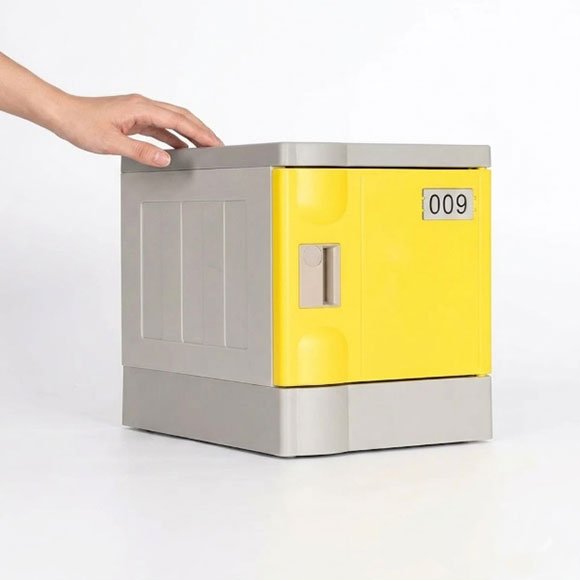
How to fix: Light burrs can be filed down with fine sandpaper and touched up with paint. Deep dents or warped panels — replace the door. ABS plastic lockers don’t have this problem, since the edges are molded as one continuous curve. If you have a mix of metal and plastic lockers, focus your inspection on the metal ones.
② Door Function — Does It Close Properly?
A door that won’t close — or closes but doesn’t latch — isn’t a minor annoyance. It’s a safety issue.
Students open and close their lockers at least 5 to 8 times a day. That’s nearly a thousand cycles per door per school year. If the hinge is bent, the latch is sticking, or the frame has twisted, here’s what happens: the door pops open mid-day and hits someone walking by. Or it closes but won’t open, and a frustrated student starts yanking at it.
How to check: Open and close every single door. Does it take a hard slam to latch? Does it stick halfway? Does the lock bolt slide into the strike plate smoothly?
How to fix: Tighten loose hinge screws. Put a drop of lubricant on a sticking latch. For doors that are physically warped — replacement is the only real fix.
③ Pinch Protection — Are the Doors Too Fast and Heavy?
In elementary schools and kindergartens, pinched fingers aren’t usually because a kid deliberately put their hand where it shouldn’t go. It’s because the door is too heavy and closes too fast for a small hand to get out of the way.
Metal locker doors are heavy. They have momentum. When a first-grader closes a steel door, the pressure on a trapped finger is significant. Swelling. Bruising. Sometimes worse.
How to check: Slowly close a door and observe the speed from half-open to fully shut. If it takes less than half a second, it’s too fast for young children.
How to fix: Install slow-close hinges on metal doors. Or replace the entire door with an ABS plastic door — which weighs about a third of a steel door. If a finger does get caught under a plastic door, the damage is much less severe.
④ Formaldehyde and Chemical Odors
New cabinets have a smell. That doesn’t mean they’re safe.
Many school lockers are made from particle board, MDF, or painted metal. The glues and paints release VOCs (volatile organic compounds) for weeks or months after installation. Schools test the air for formaldehyde in paint and flooring — but they rarely test inside the lockers.
How to check: Open a locker door and let it air out for 30 minutes. Then put your face close to the interior and sniff. If you detect a sharp chemical smell, a sweet glue-like odor, or anything that stings your nose — hold off on using that locker. For a more accurate test, use a home formaldehyde test kit. Seal the locker door for 2 hours, then test. Any reading above 0.08 mg/m³ needs action.
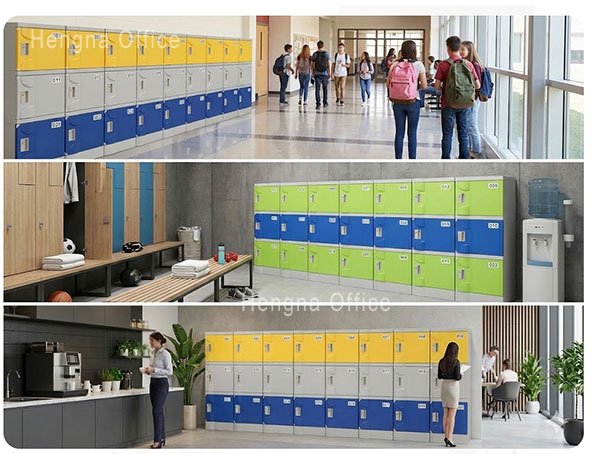
How to fix: Leave the locker open and ventilate for at least a week. If the smell doesn’t fade, the material itself is off-gassing — and the locker should be returned. ABS plastic and all-metal lockers (with no glued panels) usually air out in 2 to 3 days.
⑤ Structural Stability — Is the Cabinet Secured?
Give each locker unit a firm shake from the top.
School lockers are usually installed in a row, bolted together and sometimes anchored to the wall. But if the floor bolts are loose, or the leveling feet have shifted, a full row can tip over. Not just one unit — a chain reaction. This is the most dangerous failure point.
How to check: Place both hands on top of the cabinet and push and pull in all four directions. Any visible movement beyond 2–3 cm means the cabinet is not secure. Also check whether all leveling feet are making full contact with the floor.
How to fix: Level the cabinet, then secure it to the wall with expansion bolts. Tighten all leveling feet. For rows that can’t be wall-anchored (not ideal, but it happens), install top connecting brackets between units for extra stability.
⑥ Moisture and Mold
Lockers that sit closed all summer — especially in humid regions — are prime candidates for mold growth.
The locker itself might not rot. ABS plastic and stainless steel don’t corrode. But the moisture trapped inside over a hot, humid summer is enough to make anything stored inside smell like mildew.
How to check: Open each door and smell the interior. A musty or earthy odor means moisture has been trapped. Run your finger along the bottom interior corner — if it feels slippery or damp, there’s mold growth.
How to fix: Wipe the interior with diluted bleach or white vinegar solution. Leave the door open to air dry for a full day. Do not use air fresheners or odor neutralizers to mask the smell — that’s a temporary cover-up, not a fix. Long-term solution: choose lockers with ventilation slots in the door design, or leave a 1–2 cm gap between the locker back and the wall for airflow.
⑦ Locks and Key Management
New term, new students, and a box of unlabeled keys nobody can match to their lockers.
How to check: Test every lock — key lock, combination lock, or electronic. Mark any lock that sticks, won’t turn, or doesn’t engage the bolt fully.
How to fix: For combination locks: replace batteries and reset codes. For key locks: apply a drop of lubricant. For damaged lock cylinders: replacing just the lock core is cheaper than swapping the whole door — as long as your door has compatible lock hole dimensions.
Locker Safety Audit Checklist for Schools Quick Reference: Pre-Term Locker Safety Checklist
| # | Check Item | Pass Standard | If It Fails |
|---|---|---|---|
| 1 | Sharp edges & burrs | Glove slides smoothly | File and paint or replace door |
| 2 | Door closes properly | Latch engages with a gentle push | Tighten hinge, lubricate latch |
| 3 | Pinch protection | Closing speed slower than 0.5 sec | Install slow-close hinge or lightweight door |
| 4 | Formaldehyde / odor | No chemical smell after airing out | Ventilate 1 week, return if persists |
| 5 | Structural stability | Less than 2–3 cm wobble | Anchor to wall or level feet |
| 6 | Moisture & mold | No musty smell, no slippery surfaces | Bleach wipe + dry; improve ventilation |
| 7 | Locks & keys | All locks open and close smoothly | Replace battery, lubricate, or swap core |
Do This Every Term
School lockers get used harder than most people realize. In the 10 minutes between classes, dozens of students open and close their lockers at the same time. Over four years, a single door cycles thousands of times.
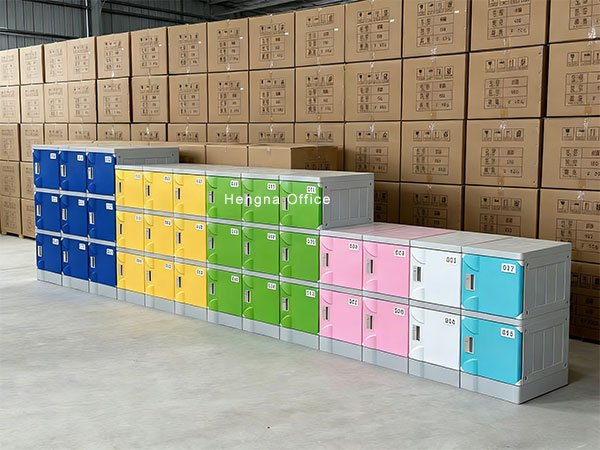
Check at the start of every term — fall and spring. Don’t just inspect. Keep a record. Note what was fixed last time so you can spot recurring problems.
If more than 10% of your lockers fail any of these checks, it’s more cost-effective to replace the whole batch than to repair individual units one at a time. The costs add up, and the old cabinets still have structural issues the new doors won’t fix.
Need a Locker Replacement Plan?
If your inspection reveals too many problems to patch up one by one, tell us about your classroom — room size, number of students, how many doors you need. We’ll send a layout plan and FOB pricing within 24 hours.