ABS Day-Use Lockers for Gyms — Coin, RFID or Key Locks for Rental Programs That Pay Off
A bank of day-use lockers is the quietest profit center in a gym. Members pay for the convenience, the front desk stops losing keys, and the changing room stops smelling like a lost-property office. The cabinet body decides whether the bank survives a sweat-soaked room; the lock decides whether the rental program runs itself or creates a second job for your staff. This guide covers both halves — the lock models and how each one changes daily operations, plus the ABS specs that matter when the bank sits ten steps from the showers. Specs reflect Hengna’s 2026 ABS locker range.

What “Day-Use” Means on a Gym Floor
Day-use is the opposite of the assigned staff locker. A member claims a compartment at 6 a.m., empties it before leaving, and the next member claims the same door at noon. The bank turns over eight or ten times a day, handles thousands of open-close cycles a year, and takes a beating from wet bags, damp towels and gym-bag zippers.
That turnover is the business case. One compartment serving many members a day is what makes rental pricing work — and what makes lock choice the real decision. A cabinet that needs a staff member to manage keys, reprint codes or fix jams does not run a program; it runs a queue.
The Lock Decision: What Each Model Does to Your Front Desk
Three lock families dominate gym rental programs, and each one runs a different operation:
| Lock type | How members use it | What your staff handle |
|---|---|---|
| Key lock | Desk swaps a key for collateral; simple, familiar | Key inventory, losses, rekeying |
| Combination lock | Member sets or receives a code per visit | Nothing, if codes reset each session |
| RFID card lock | Membership card opens the door | Card system setup only |
One more model circulates in the gym market: coin-operated locks, where the member pays a small refundable deposit at the door. If coin operation is part of your plan, raise it with the supplier early — Hengna’s standard range covers key, four-digit combination, RFID card and fingerprint locks, and coin variants are a separate specification worth confirming rather than assuming.
The operating logic worth knowing: combination and RFID locks reset or reassign without staff, which is why chains favor them for day-use banks. Key locks survive heat and humidity with the least electronics, which is why they remain the pick for the wettest corners. Most gyms end up mixing models by zone rather than standardizing.
Why ABS for a Sweat Environment
Sweat is salt water with attitude. It lands on doors and handles, dries, and pulls moisture out of the air on its own. On painted steel, that film works into every fastener hole and hinge — the rust streaks down gym locker doors are salt maps. Cleaning crews then wipe everything with chlorine-based sprays twice a day, which finishes what the sweat started.
ABS lockers have no coating to lose. The material is waterproof through its full thickness, color runs through the panel, and a scrub with soap and water resets the surface. Impact matters too: dropped dumbbells, kicked doors and jammed bags dent painted steel and crack laminate; a molded ABS door flexes and moves on. Molded design life exceeds 20 years, which is the figure that matters when the bank amortizes across a decade of membership cycles.
Sizing the Bank: Modules That Fit a Gym Floor
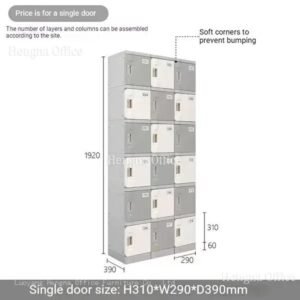
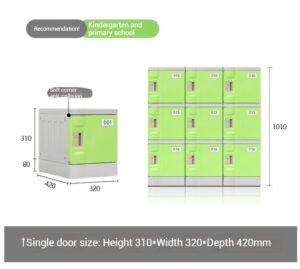
The module system behind Hengna’s range runs from 2 to 27 doors, with door widths from 290 to 480 mm, depths from 390 to 500 mm, and overall heights up to 2100 mm. For day-use programs, two configurations do most of the work:
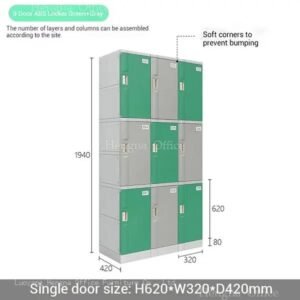
- Six-door banks — 930 mm door modules, three across and two tiers up, 1940 × 1146 × 500 mm overall. The workhorse: every compartment fits a duffel, shoes and a towel stack, and the top tier stays within reach.
- Full-height single-door columns — for premium or long-stay members who want hanging space, placed against the dry wall with key locks.

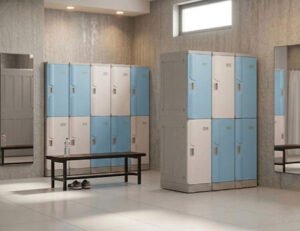
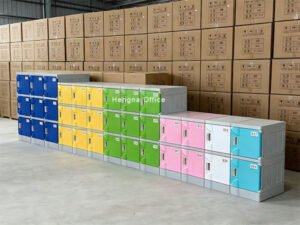
Color is the cheap version of a finding system. Two of the 8 standard colors per zone — one pair for the women’s room, another for the men’s, a third for the studio floor — and members navigate by color before they read a single number plate. Custom colors open up on volume orders.
The Rental Program Math, Without the Hype
No prices here — every market differs — but the structure of the payback is the same everywhere, and it is worth walking through before you size the order:
- Count the turns. A day-use compartment in a busy club serves several members daily; annual rental income per door is the daily fee multiplied by realistic occupancy, not the fantasy rate from the business plan.
- Subtract the staff cost. Key programs pay a receptionist to manage inventory; combination and RFID programs pay nobody. That saved hour is part of the lock decision, not a rounding error.
- Subtract the maintenance. Painted steel in a sweat corner needs repainting cycles; ABS needs a cloth. Over five years the maintenance line rivals the purchase line.
- Count the lost-property minutes. A bank that resets itself ends the “someone took my bag” conversations at the desk.
Run those four lines for your own club and the bank size answers itself — the order that pays back fastest is rarely the biggest one.
Where Gyms Get This Wrong
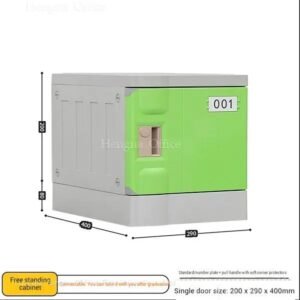
Three placement mistakes cause most of the complaints. First, banks parked next to the showers with electronic locks: condensation finds the circuit boards within a season — the wet corner wants key locks. Second, banks flush against the floor: mop water sits in the splash line, which is why the 80 mm molded base matters more in gyms than the spec sheet suggests. Third, single-model lockouts: standardizing the whole room on one lock type forces either a staff-heavy key desk or electronics in a wet corner. Zone by zone, not wall by wall.
Ordering From Hengna
Luoyang Hengna Office Furniture Co., Ltd. supplies the ABS locker range on a manufacturer-direct basis for gym and fitness projects, with OEM support covering silk-screen logos, custom packaging and custom manuals. Every order ships knock-down in foam and corner-guard packing, assembles tool-free on site, and carries a one-year warranty. Send your floor plan, lock mix and door count — the quote comes back within 24 hours.
Common Questions
What is the minimum order quantity?
Sample banks for a single changing room are accepted; container quantities bring the better unit pricing. Share the door count and lock mix for an exact figure.
Can we mix lock types in one order?
Yes — and most gym buyers do. Key, combination, RFID and fingerprint locks can be mixed across banks in the same shipment, matched to each zone’s humidity and staffing.
Do combination locks need reprogramming after every member?
Four-digit combination locks are reset per session by the member or staff, depending on the model. Confirm the reset method with the supplier before ordering — it is the difference between a self-running bank and a desk job.
Can the gym logo go on the doors?
Yes. Silk-screen logo printing, custom packaging and custom manuals are standard OEM options on volume orders.
If this size is close but not quite right, the full ABS locker range puts every model in one table — door count, height, compartment size and lock options.
FOB or CIF — how do you quote?
Both. Send the destination port and preferred terms; the quote with warranty, lock options and current lead time returns within 24 hours.