Hot Desk Lockers in ABS Plastic — Day-Use Storage Hybrid Offices Can Reassign Every Morning
Hot desking solved the desk problem and created a storage one. When nobody owns a desk, nobody has a drawer — laptops, gym gear and jackets end up on chairs, floors and the one shelf by the printer. A day-use locker bank is the missing furniture, and the spec that separates a working installation from a shelf with doors is reassignment: whether the lock hands the compartment to a new person every morning without an administrator in the loop. This guide covers the lock models that make reassignment work, what fits in a hot-desk compartment, and where ABS earns its place in an office. Specs reflect Hengna’s 2026 ABS locker range.
Why Assigned Lockers Stopped Working
The old model assigned one locker per employee, permanently. In an office where people come in two or three days a week, that math strands half the compartments empty on any given day — a hundred-door wall serving a Tuesday population of forty. Facilities teams respond by printing reassignment spreadsheets, which age badly.
Day-use flips it: the compartment belongs to whoever checks in that morning. One bank now serves the whole rotating population of a floor, the same way the desks do. The cabinet barely changes — the lock is what makes the flip possible.
What “Reassign Every Morning” Actually Requires
Three lock families can run a day-use bank, and they differ in exactly one thing: who resets the compartment between users.
| Lock model | How reassignment works | Daily admin |
|---|---|---|
| 4-digit combination | Member sets a private code; supervisor master-reset between stays if needed | None to minimal |
| RFID card lock | Membership or access card opens the door; card deactivation frees the compartment | None once cards issued |
| Key lock | No reassignment — compartment travels with its key | Key log at reception |
Combination and RFID models are the day-use pair. RFID deserves one extra question before ordering: for banks that reassign automatically against a membership system, confirm the lock’s electronics rating and whether the networked version is part of the supplier’s standard range. Fingerprint locks also exist in the range and suit executive or IT-storage banks where biometric access is the policy.
Key locks are not the enemy — they are the assigned model, and they still run gym-style day rental through a deposit swap at reception. They just do not reassign by themselves. Matching lock model to compartment group beats standardizing the whole wall.
What Fits in a Hot-Desk Compartment
The standard kit a hybrid worker carries: laptop bag, change of shoes, gym kit, jacket, lunch. Compartment sizing decides whether all of that lives in one door or gets Tetris-ed across two.
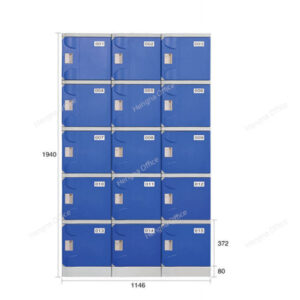
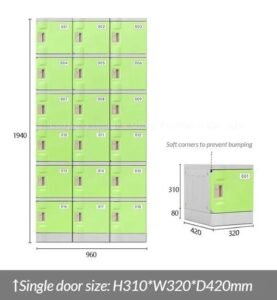
- Full-height single door — a 1940 × 382 × 500 mm column with a built-in coat rod and storage box: jacket hangs, bag drops, helmet stows. The assigned-feeling option that still rotates daily.
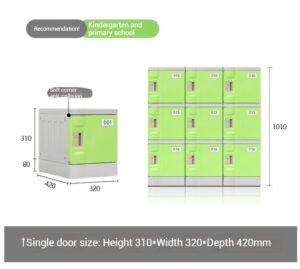
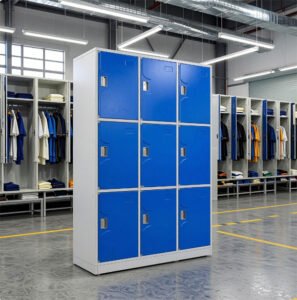
- Two-tier banks — 930 mm door modules, 382 mm wide, 500 mm deep, three columns across. Upper tier for bags and laptops, lower for shoes and gym kit.
- Four-tier and up — 465 mm modules for laptop-only banks in hot-desk lounges, where members store less and turn over faster.
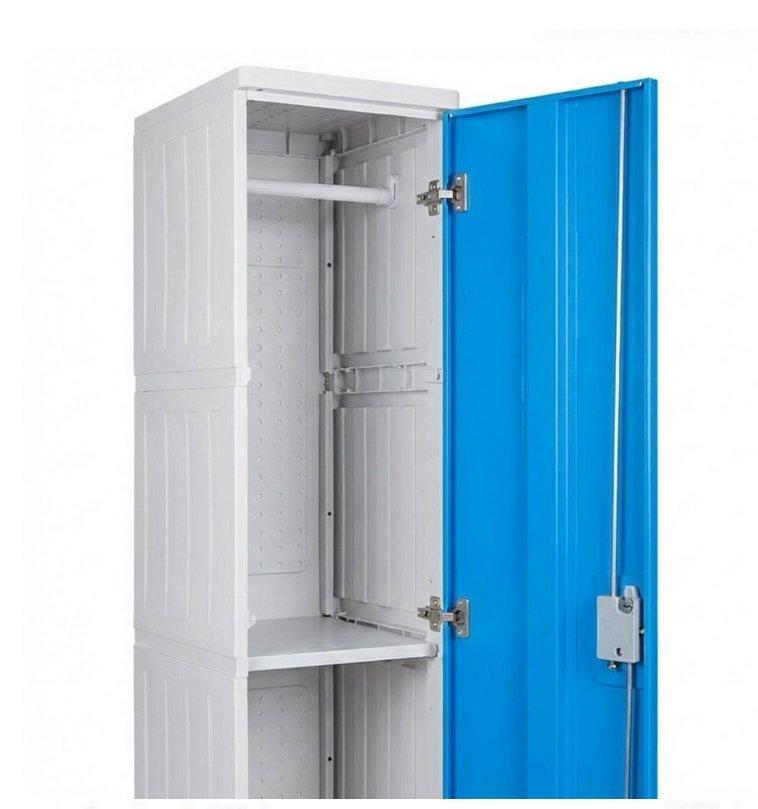
Inside every compartment, a molded coat rod and a storage box do the quiet work: wet jackets hang instead of steaming a laptop bag, and small items stop migrating to the floor. The 80 mm molded base keeps door edges off floor-cleaning water — a detail that matters as much in offices with nightly scrubber machines as in gyms.
Why ABS in a Dry Office — the Honest Case
Offices are not wet rooms, so here is the case without the waterproofing crutch. Painted steel lockers in offices fail socially before they fail physically: drums and echoes in a quiet floor, chips at the corners within a year, repaint cycles that smell the place up. Laminate-fronted cabinets look right and scratch badly.
ABS brings the material logic indoors: color runs through the panel, so scuffs stay cosmetic; the surface wipes down with the same sanitizing wipes the cleaning crew already uses; rounded corners and quiet closing suit a workspace; and the molded design life exceeds 20 years. Floor loading is lighter than steel, which matters on raised floors and mezzanine levels. Where ABS genuinely has no argument is a wet corner — lobbies beside entrance matting, end-of-trip rooms with showers and bike storage — where it stops being a preference and becomes the requirement.
Placement and Layout Notes
Four rules that keep a bank useful after the ribbon-cutting:
- Put the bank where the day starts. Beside the entrance and the coffee point, not buried at the core — a locker nobody passes is a locker nobody resets.
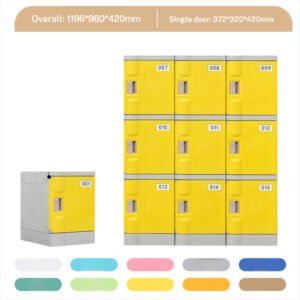
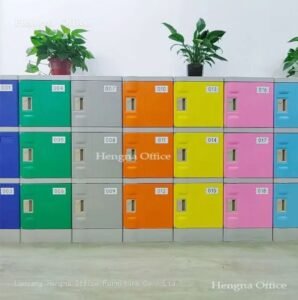
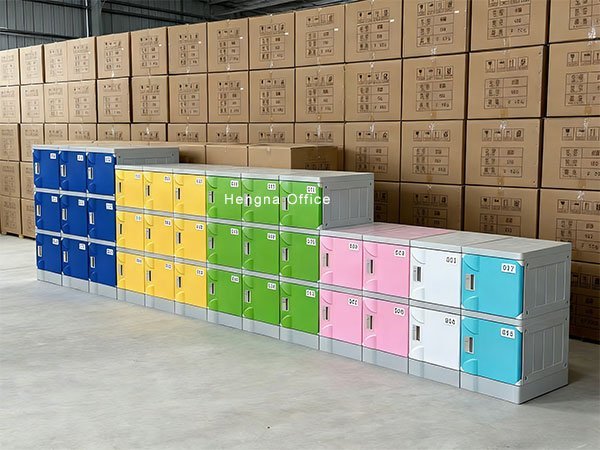
- Zone by color, not signage. Two of the 8 standard colors per floor or team cuts “which one is mine” questions to zero.
- Keep the wet corners plastic. End-of-trip rooms, plant watering corners, entrance lobbies — assign ABS banks there and the paint-chip problem never starts.
- Leave room for the turn. Banks work when the door swings fully open; 500 mm depth plus a person equals about a meter of clear floor in front.
Delivery, Assembly and the Elevator Test
Office fit-outs run on tight schedules and tighter elevators, so the logistics deserve their own check. Hengna banks ship knock-down: panels flat in cartons, wrapped in foam with corner guards, sized to ride a standard service elevator without tilting. Assembly on site is a snap-fit job — no drills, no dust, no noise complaints from the floor above, and no hot works permits. A two-person team stands up a bank in minutes per unit.
The same construction pays off twice more during the bank’s life. Repositioning a bank for a floor reshuffle is an unbolting job, not a demolition. And when a single door takes damage, the panel swaps out — no repainting a whole wall to fix one corner.
Ordering From Hengna
Luoyang Hengna Office Furniture Co., Ltd. supplies the ABS locker range on a manufacturer-direct basis for workplace projects, with OEM support covering silk-screen logos, custom packaging and custom manuals. Banks ship knock-down in foam and corner-guard packing, carry through elevators in parts, and assemble tool-free on site in minutes per unit. Warranty is one year, and quotes come back within 24 hours — send the floor plan and the lock mix.
Common Questions
Can we mix full-height and two-tier banks in one order?
Yes, and most workplace orders do — full-height columns near the entrance for commuters, tiered banks in project areas for laptop bags. One color program ties the wall together.
What happens when someone forgets their combination?
Supervisor master keys or reset procedures cover it, the same way a front desk handles a misplaced room key. Confirm the reset mechanism with the supplier before ordering so the process has an owner.
Do RFID locks work with our existing access cards?
RFID card locks are part of the standard range; integration with an existing building card system depends on the card platform. Raise it at quotation with the card type in hand.
Can the company logo go on the doors?
Yes. Silk-screen printing, custom packaging and custom manuals are standard OEM options on volume orders.
Working out how many doors the room actually needs? The full range with dimensions lists them side by side so you can match a size to a wall length in a few minutes.
FOB or CIF — how do you quote?
Both. Send the destination port and preferred terms; the quote with warranty, lock options and lead time returns within 24 hours.