Office Locker Ratio: How Many Compartments for 30, 50 or 100 Staff
The answer is not the number of staff. It is the number of people who need a locker at the same moment — and in an office that is usually fewer than the payroll, for a reason most fit-out budgets never account for.
This page works through three office sizes, because the arithmetic changes more between 30 and 100 people than most people expect. It also covers the two decisions that matter more than the count: what has to fit inside the compartment, and where the bank can physically go.
Why Headcount Is the Wrong Starting Number
A 30-person office does not need 30 lockers. It needs enough for the people who actually leave something on site.
Three groups decide the real number:
- Staff who commute by car and leave a coat and shoes — they use a locker every day
- Staff who carry everything in a bag — they often use it once, then stop
- Staff who are on site two or three days a week — they want a locker, but not a dedicated one
In most offices the first group is 40–60% of the headcount. The second is larger than anyone admits when the specification is written.
The practical starting point is not headcount but peak occupancy: how many people are in the building on the busiest normal day. That figure, not the org chart, is what a bank should be sized against.
The 30-Person Office
Small enough that one bank does the job, and small enough that getting it wrong is visible every day.

| Assumption | Provision |
|---|---|
| Everyone on site daily, coat and shoes stored | 28–30 compartments |
| Everyone on site daily, bags only | 18–22 compartments |
| Hybrid, 2–3 days on site | 20–24 compartments |
| Hybrid plus 4 hot desks | 16–20 plus 4–6 day-use |
The difference between the first row and the last is a wall run of roughly 1.4m — enough for a bench, which matters more than four extra doors nobody opens.
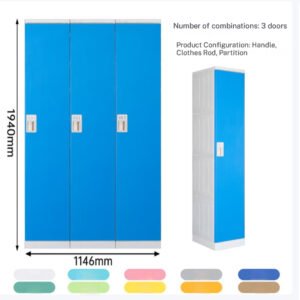
At this size, one decision usually settles the rest: does anyone store a coat? A coat needs a full-height compartment or a hanging rod. A bag only needs a shelf. Specifying full-height for a bag-only office wastes the most expensive dimension in the room.
The 50-Person Office
This is where hot-desking starts to change the arithmetic, and where most mistakes happen.
If half the staff hot-desk, the desk count falls but the storage demand does not always follow. People who hot-desk still arrive with a coat, a bag and sometimes a change of shoes. What changes is that they cannot leave anything behind.
Two workable models:
Assigned lockers for everyone, sized to peak occupancy. Simple to administer, wasteful on quiet days, and the model most offices default to.
Day-use compartments plus a smaller assigned block. Smaller total count, but only works if the lock can be reset quickly and someone owns the allocation policy.
The mixed model usually lands at 30–35 compartments for 50 staff: a block of fixed lockers for the people who genuinely store kit, and a bank of day-use compartments near reception for everyone else.
One detail that decides whether the mixed model survives: the day-use compartments must be within sight of someone. Behind a fire door on the second floor, they become personal storage within a month.
The 100-Person Office
Past about 80 staff, the single-bank model stops working — not because the doors run out, but because the walk does.
Three things change at this size:
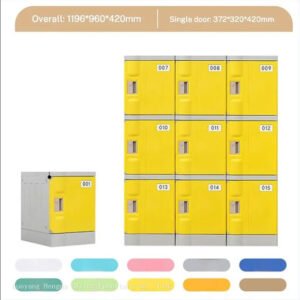
- Split the storage, not just the count. Two or three smaller banks near the areas people work beat one long run by the entrance.
- Number by zone, not sequentially. A continuous run from 1 to 100 means nobody can guess where 63 is.
- Reserve a visitor block. Twenty day-use compartments near reception stop visitors from being walked to a staff area.
A 100-person office on a hybrid pattern typically lands at 60–70 compartments split across two banks, plus 8–10 day-use at reception. That is a smaller total than one-per-person, and it is easier to administer because each bank has an obvious owner.
What People Actually Store
Compartment size decides more than compartment count, and it is the specification most often copied from a previous project.

| What is stored | Minimum internal height | Notes |
|---|---|---|
| Coat on a hanger | 900–1000mm | Needs a rod, not a shelf |
| Backpack | 450–500mm | Check the depth: many are 300mm+ |
| Laptop bag | 350mm | Fits a 400mm compartment on its side |
| Shoes only | 200mm | Two-tier works |
| Helmet and boots | 300mm per tier | Boots need 320mm depth minimum |
| Documents and files | 320mm | A4 lever-arch file is 320mm tall |
Two things this table exposes. A coat is the single item that forces full height, and a lever-arch file is taller than most people estimate. If the office stores both, full-height units with a shelf are cheaper than two separate banks. Where bags and shoes are all that is stored, a half-height bank costs less per door and leaves the wall above free.
Compartment Size Before Compartment Count
The most common office specification error is settling the count before the size.
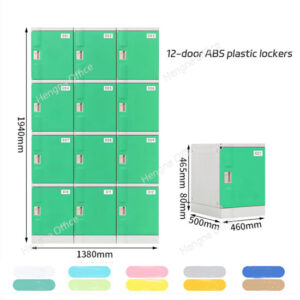
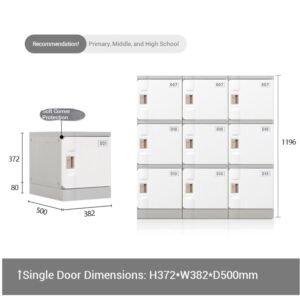
A 400mm-deep compartment holds a bag and a pair of shoes. A 500mm-deep one holds a coat on a hanger without crushing it. That 100mm changes the wall run per door, which changes the count that fits, which changes the budget.
Settle the three numbers in this order: what has to hang, what has to lie flat, and what the tallest stored item is. Everything else — door count, tier layout, bank length — follows from those. If you are writing the enquiry next, the seven numbers a supplier needs are the ones to fix first.
Where the Ratio Breaks
Four situations where a standard office ratio gives the wrong answer:
- The office runs shift patterns. Overlapping shifts mean peak occupancy is higher than headcount suggests.
- Staff are on site for 12-hour days. People store more when they stay longer — food, changes of clothes, medication.
- The building has no coat storage elsewhere. If there is no cloakroom, the locker bank absorbs everything.
- The site hosts regular visitors or contractors. They need day-use compartments, and they will use staff lockers if none exist.
In each case the answer is not a different ratio. It is a different question: who is in the room, and what are they carrying?
FAQ
How many lockers does a 50-person office need?
Between 30 and 35 on a hybrid pattern, or close to 50 if everyone is on site daily and stores a coat.
Do hot-desking offices need fewer lockers?
Fewer assigned lockers, not necessarily fewer compartments. The demand shifts to day-use units near reception.
What size locker fits a coat?
About 900–1000mm of internal height plus a hanging rod, which usually means a full-height unit. Where the office needs a mix of hanging and shelf space, see the height options.
Should lockers be assigned or day-use?
Assigned for staff who store kit daily; day-use for hybrid and visitor use. Most offices end up with both.
Where should the bank go?
Where people already walk, and within sight of a desk or reception. Storage in an unvisited corner stops being used.
Still weighing a different tier layout? The complete locker range puts every model in one table — door count, height, compartment size and lock options.
The Number Most Offices Get Wrong
Not the door count. The peak occupancy figure.
Ask facilities how many people are in the building on a normal Tuesday, and the answer is usually a guess. That guess is what the whole bank is sized against — and it is the one number worth measuring properly, because it costs nothing to count and everything to get wrong.
Updated November 2026.