Employee Locker Specification: 7 Numbers to Fix Before You Request a Quote
A locker quote is only comparable if both sides are pricing the same thing. Most are not, and the gap is rarely the door count — it is six other numbers nobody wrote down.
This page lists the seven figures that decide the price, in the order they should be fixed. Get them settled before you send an enquiry and the quotes that come back will be comparable. Skip two or three and you will spend a week working out why one bid is 30% cheaper.
1. Door Count per Bank
Not the total. The count per bank.
Twelve doors in one unit and twelve doors across two units of six are different products with different footprints, different fixing requirements and often different prices. A supplier quoting “12 doors” without saying how they are grouped has not quoted anything yet.
State it as: 12 doors per unit, three units, 36 total. That single line removes most of the ambiguity from the first round. If the count is still open, the door count guide maps compartments to people.
Also worth stating: whether the bank must be extendable later. A unit designed to bolt onto a matching run costs slightly more than a standalone cabinet, and it is the difference between a second phase that matches and one that does not.
2. External Dimensions and Tolerance
Width, depth and height, plus how much variation is acceptable.
| Dimension | Why it matters | What to state |
|---|---|---|
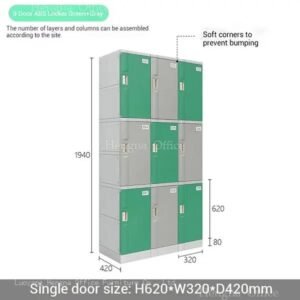
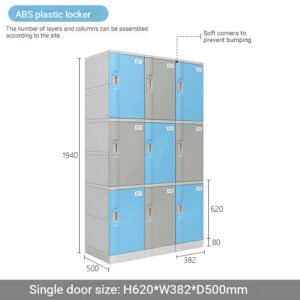
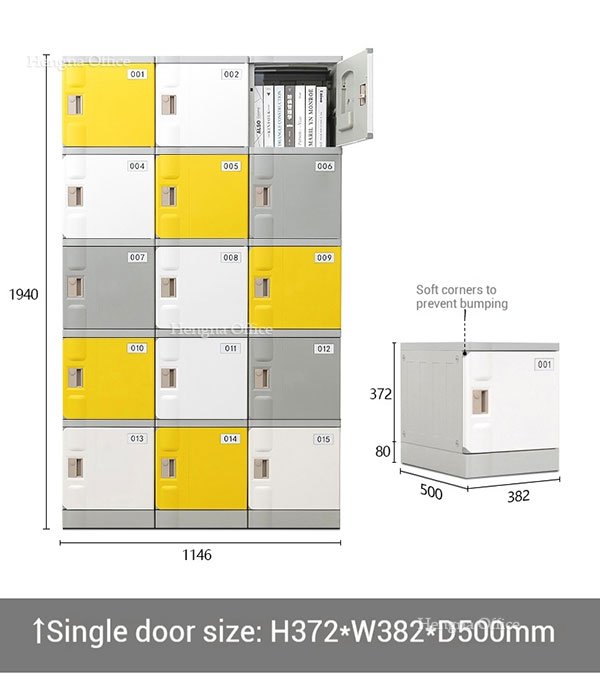
| Depth | Decides wall run and corridor clearance | 400, 450 or 500mm |
| Width per door | Decides how many fit in the run | Usually 300–400mm |
| Height | Decides tier count and reach | 1100, 1500 or 1940mm |
| Tolerance | Decides whether it fits a recess | ±2mm on depth is common |
Tolerance is the number nobody asks for and everybody argues about on delivery day. A 500mm nominal depth that arrives at 512mm does not fit a 510mm recess, and that is a site problem, not a manufacturing fault.
If the bank goes into a recess, measure the recess at three points. Walls are rarely straight, and the narrowest point is the real constraint.
3. Tier Configuration
One tier, two tiers, three, or a mix within one cabinet. The tier configurations are the same options described in more detail elsewhere; what matters here is that the quote states them per unit.
The trade-off is simple and unforgiving: more tiers means more compartments per metre of wall, and less height in each. What people can store follows directly from that.
- One tier — coats, coveralls, full bags
- Two tiers — bags, shoes, a folded jacket
- Three tiers and above — small items only; nothing that hangs
State the tier count per unit, not just the total door count. Three-tier units and single-tier units can share the same door count and be entirely different products.
If the site needs both — hanging space for some staff, cubbies for others — say so. Mixed banks cost more to plan and less to live with.
4. Lock Type and Key Control
The lock is where a cheap quote and an expensive one diverge most, and where post-installation costs accumulate.
| Lock type | Suits | Hidden cost |
|---|---|---|
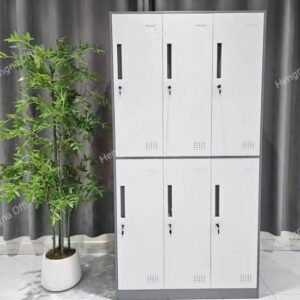
| Keyed cam lock | Assigned lockers | Key replacement, master key admin |
| Hasp and padlock | Shared or self-managed | Padlocks bought by users, quality varies |
| Mechanical combination | Shared, quick reset | Code administration |
| RFID or electronic | Managed sites | Cards, software, integration |
Two questions to settle before quoting:
Is a master key required? If yes, the lock series matters, and it must be stated. A master key system added later usually means replacing locks.
Who resets a lost key or code? If the answer is “the supplier”, that is a service with a cost. If it is “our facilities team”, the lock needs to be resettable without special tools.
5. Fixing Method and Wall Type
How the unit is held to the wall, and what the wall is made of.
This is the item most often left off a quote and most often missing on delivery. A wall-mounted or raised-base unit that is not fixed is a unit someone can pull over.
Four common wall types, four different fixings:
- Masonry — expansion anchors, straightforward
- Stud partition — needs to find the studs, or a plywood pattress behind
- Drylined blockwork — long anchors through the lining
- Steel frame — self-drilling fixings, load-limited
State the wall type in the enquiry. A supplier who quotes without asking has assumed masonry, and masonry is not the default in modern buildings.
6. Packed Volume and Weight per Carton
This decides freight, and freight is often a bigger line than the hardware.
Three figures per carton: packed dimensions, gross weight, and how many cartons per unit.
Why it matters beyond cost: a carton that cannot pass through a 900mm door, or one that weighs more than two people can lift up a stairwell, becomes a site problem on delivery day. Flat-packed units solve the door width issue and create an assembly task instead.
State whether the delivery point is kerbside, ground floor or inside the building. It changes both the freight price and what the site needs to have ready.
7. Minimum Order and Lead Time
Two numbers that decide whether a quote is real.
Minimum order — per colour, per size or per model, not always the same. A 20-unit minimum on standard grey can become 100 units on a custom colour.
Lead time — split it into standard colour and custom colour, because they are usually different by several weeks. Also ask what the lead time is measured from: order, artwork approval or deposit.
For a phased installation, say so. A supplier who knows the second phase is coming in six months will quote differently from one who thinks the order is complete.
When Two of the Seven Conflict
They usually do, and the order of priority is not obvious.
Depth wins most arguments. A corridor clearance or a recess limits depth, and no other dimension compensates — a 500mm cabinet does not fit a 400mm gap by changing the tier count.
Door count bends. If depth forces a shallower unit, the same wall run holds fewer doors, and the count has to fall before the price does.
Lock type is cut last. It is the part people touch every day, and a cheap lock is the most common source of complaints in year one — usually a key that sticks, not a lock that fails.
Where the seven numbers cannot all be satisfied, fix depth first, then count, then lock.
What the Seven Numbers Do to the Price
Roughly, in order of impact:
| Number | Typical effect on price |
|---|---|
| Door count | Near-linear |
| Dimensions | Moderate; depth above 500mm climbs faster |
| Tier configuration | Small per unit, large on installation labour |
| Lock type | Large range — electronic can multiply the lock cost |
| Fixing method | Small per unit, significant if wall preparation is needed |
| Packed volume | Large; freight is often the swing factor |
| Minimum order and lead time | Decides whether a custom colour is viable at all |
Need the wider picture before quoting a client? The locker range overview breaks each one out by door count and tier, with the dimensions on the same line.
What to Send Instead of a Specification
You do not need a written specification to get a comparable quote. You need seven lines:
- Doors per unit, units required, total
- Width × depth × height, plus tolerance
- Tier layout
- Lock type, and whether a master key is needed
- Wall type and fixing preference
- Delivery point and access restrictions
- Required date, and whether a second phase follows
Send those and any competent supplier will quote the same product. Leave them out and you will be comparing seven different products that happen to share a door count.
Updated November 2026.