Shower Room Lockers 101 — Why Steel Hinges and Paper Labels Fail First in Wet Rooms
Ask a facility manager why a wet room cabinet got replaced, and the answer is almost never “the body fell apart”. It is the small parts that go first: hinges rust into a grinding sag, paper labels swell into grey pulp, locks seize half-turn from closed. The cabinet shell often has years of life left when the door barely swings. This guide walks through each failure in order, what causes it, and what to check before you order. Examples reference Hengna’s 2026 ABS locker range.
Why the Small Parts Fail First in a Shower Room
A shower room cycles hard. Humidity sits at 60 to 90 percent for hours after the morning rush, then condensation forms on every surface cooler than the air overnight. Cleaning crews add chlorine-based sprays and floor chemicals daily. Warm water vapor finds every gap, and the places it collects are never the flat painted middle of a door — they are the screw holes, the folded edges, the paper card in the window, the lock barrel, and the feet sitting in the splash line.
The pattern to memorize: big flat panels are easy to protect; small, crevice-filled parts are not. Judge a wet room cabinet by its hinges, labels, locks and base before the body.
Steel Hinges — the First Part to Go
On a painted steel locker, the hinge is where the coating loses. Hinges get drilled, screwed and flexed, so the paint cracks exactly where bare metal shows. Rust blooms around the pin, the door starts to grind, then sags until the latch no longer lines up. It rarely takes more than two or three seasons in a real shower room.
Before ordering, ask the supplier one question: what is the hinge made of? The answers that hold up in wet rooms are hinges molded from the same plastic as the door, or solid stainless steel. A thin plated hinge on a steel door, no matter how good the paint, is the failure you just read about waiting to happen. Get the answer in writing with the quote.
Paper Labels — the Part Everyone Underestimates
Paper fails quietly and expensively. A soaked card swells, the ink runs, and suddenly a hundred guests are opening the wrong doors while staff reprint the whole set. Facilities that have lived through one wet season of pulped labels never buy paper holders again.
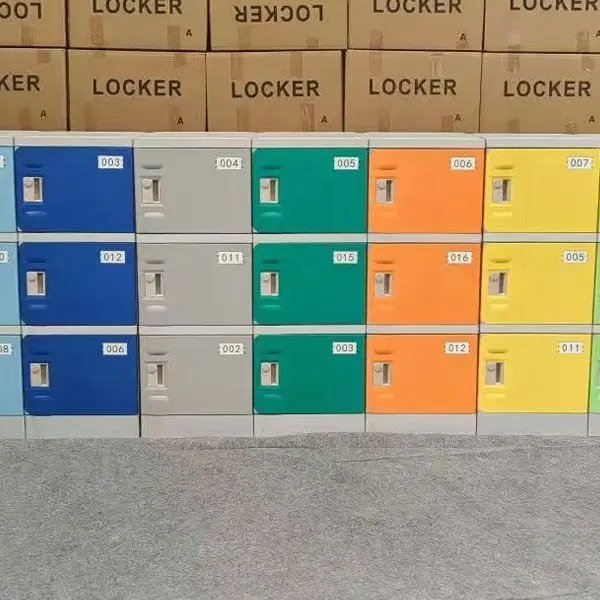
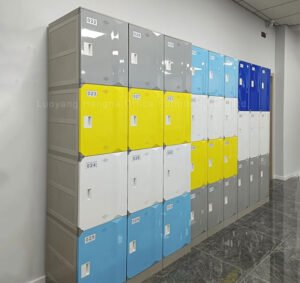
What works in a wet room is numbering that does not absorb water: number plates molded into the door itself, or a recessed plastic window holding a replaceable card behind a sealed face. The photo above shows door banks fresh off Hengna’s production line — every door carries its own molded number plate, and none of them will turn to pulp in January.
Locks — Where Cheap Seizes
Locks collect water and keys collect corrosion. A steel key in a steel barrel, cycled daily by wet hands, starts sticking within months; the cheap fix — graphite or oil — attracts grime and makes it worse. Combination wheels stiffen for the same reason. Electronic locks add circuit boards to a room that condenses overnight, so an unrated board dies in its first humid season.
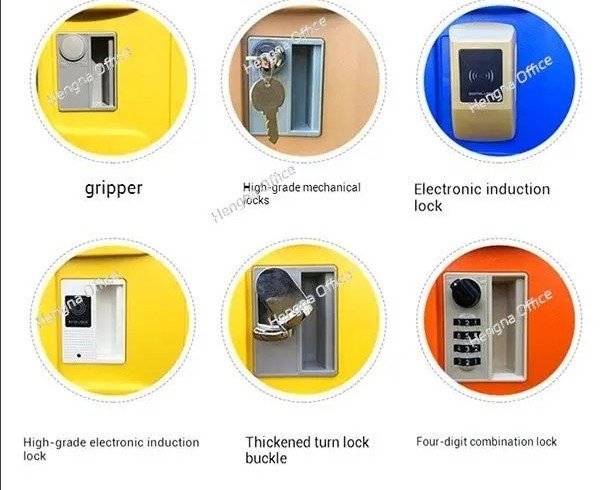
Match the lock to the zone rather than ordering one type for the whole room. Key locks belong in the warmest, wettest corner because they have the least to break. Combination and RFID locks belong on banks in the cooler end, where electronics live longer. Whatever you choose, ask for the lock’s operating temperature and humidity rating — any supplier building for spas will have it on file.
The Floor Line — Where Cabinets Get Drowned
The bottom 100 millimeters of any wet room cabinet lives in the splash zone: mop water, floor squeegees, the occasional real puddle. On steel lockers this is where paint chips, feet rust, and the corrosion climbs the body from below. Wooden bases swell and rock on the tile.
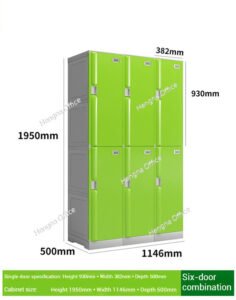
The clean solution is height. An 80 mm raised base keeps door edges, hinges and the lowest shelf above the daily wet zone — and on an ABS cabinet the base is molded as part of the same body, with no joint and no fastener for water to work into.
A Ten-Minute Buyer’s Checklist for Wet Room Cabinets
Run any quote through these seven checks before signing:
- Hinge material — molded same-material or solid stainless, stated in writing.
- Label system — molded number plates or sealed plastic card windows; no open paper holders.
- Lock rating — operating temperature and humidity range for any electronic lock.
- Base height — 80 mm or similar, molded rather than screwed on.
- Body material — color through the panel, so scratches stay cosmetic.
- Assembly — tool-free snap construction means no fastener holes to corrode later.
- Design life — a molded plastic figure over 20 years beats a paint warranty measured in months.
How the Cabinet Body Compares While You Are at It
Body material decides how much the small parts matter. The quick version:
| Material | Wet room behavior | The catch |
|---|---|---|
| Injection-molded ABS | Waterproof through full thickness, color runs through, no coating to break | Costs more upfront than painted steel |
| Coated steel | Strong and cheap | Every hole and hinge is a coating break; rust starts there |
| MDF or wood | Looks warm, suits dry lobbies | Swells permanently once the surface film cracks |
HDPE is the other plastic worth a mention — it flexes where ABS stays rigid, and the trade-offs deserve their own article. For fixed banks in a shower room, ABS holds shape and keeps doors closing square longer.
What No Locker Material Fixes
An honest closing note: a cabinet cannot out-engineer a sealed room. If the shower room has no extraction fan, condensation will work on mirrors, ceilings, door frames and guests’ patience no matter what the lockers are made of. Ventilation, a floor drain that actually drains, and a cleaning routine that leaves doors open to dry at night — those three buy more locker life than any purchase order. Get the room right, then choose parts that survive it.
Where Hengna Fits In
Luoyang Hengna Office Furniture Co., Ltd. builds the ABS locker range covered above — molded number plates, raised bases, zone-matched lock options and tool-free assembly — on a manufacturer-direct basis with OEM support for silk-screen logos and custom packing. Banks ship knock-down with foam and corner guards, carry a one-year warranty, and quotes come back within 24 hours.
Common Questions
Can I retrofit better labels onto steel lockers I already own?
Sometimes. Sealed plastic card windows can be riveted over old paper holders, moving the water problem one layer out. If the doors themselves are already rusting at the hinges, budget the replacement instead of dressing it.
What maintenance do ABS lockers actually need?
Soap, water, a soft cloth, and open doors at night so compartments air out. No repainting, no touch-up pens, no hinge oiling rounds.
Which lock should go next to the showers?
Key locks — the simplest mechanism survives the wettest corner with the least attention. Keep electronics for the drier end of the room.
Do molded number plates come in custom ranges?
Yes. Numbering sequences, color coding by floor or zone, and OEM layouts are all configurable on volume orders.
Still weighing a different tier layout? The locker range overview shows what each configuration holds in practice, not just the millimetre numbers.
Can we order a sample bank first?
Yes — sample orders covering a single changing room are accepted, so you can run one season before committing the whole budget.