Why Are ABS Plastic Lockers Ideal for Industrial Workplaces? Complete Guide for Factory Managers
Industrial workplaces require heavy-duty storage solutions that can withstand harsh conditions while protecting workers’ personal belongings. Traditional metal lockers have long been the default choice, but they come with significant drawbacks: rust, maintenance costs, and limited lifespan in demanding environments. ABS plastic lockers have emerged as a superior alternative, offering superior durability, safety, and long-term value.
The True Cost of Traditional Metal Lockers
Before exploring the advantages of ABS plastic lockers, it is essential to understand the hidden costs of traditional metal lockers in industrial settings:
Maintenance costs: Steel lockers in industrial environments need annual painting and rust treatment, lock replacements, door adjustments, and deep cleaning—every year, on top of the purchase price. Most are replaced after 5-7 years, which means another purchase, another installation, and more downtime.
10-year picture: Initial purchase, ten years of maintenance, and at least one replacement cycle add up to a total far higher than the purchase price alone. Downtime and operational disruption from replacement projects are difficult to quantify but significant.
These numbers reveal why facility managers are actively seeking alternatives that deliver better long-term value.
Chemical Resistance That Outperforms Metal

Industrial environments often involve exposure to oils and lubricants, cleaning chemicals and degreasers, acids and alkalis, solvents, and salt. ABS (acrylonitrile butadiene styrene) is a thermoplastic polymer with inherent chemical resistance. Unlike metal, which reacts chemically with many substances, ABS remains inert when exposed to most industrial chemicals.
How ABS resists chemicals: The material does not rust, corrode, or degrade when contacted by oils, greases, dilute acids, alkalis, or cleaning solutions. No paint to peel, no coating to chip, no exposed metal to oxidize. The chemical resistance is inherent to the material, not a surface treatment that wears off over time.
Real-world validation: A manufacturing plant in Ohio installed ABS lockers in their maintenance shop in 2019. Workers regularly store tool bags covered in grease, oil, and metalworking fluids. After 5 years: zero chemical damage, no staining, surfaces wipe clean with standard cleaners. Steel lockers in the same environment showed rust within 12-18 months and required complete replacement after 4 years.
Impact Resistance for Heavy-Duty Use
Industrial workers are tough on equipment. Lockers face tool bags weighing 20-50 lbs dropped into compartments, steel-toed boots kicked into doors, heavy equipment bumped against surfaces, forklift impacts in high-traffic areas, and daily door slamming.
How ABS handles impacts: ABS plastic flexes on impact and returns to shape. The material absorbs energy rather than denting permanently. Injection-molded construction distributes force across the entire surface. No paint to chip, no coating to crack, no bare metal exposed from impact points.
Impact testing data: ABS lockers withstand impacts of 15-20 joules without permanent deformation. Steel lockers dent at 5-8 joules. ABS recovers from impacts that would permanently damage steel.
Real-world validation: An automotive parts factory installed ABS lockers in 2018. After 6 years of daily abuse from tool bags, steel-toed boots, and equipment impacts: zero door dents, all hinges functioning, no structural damage. Steel lockers in the same facility required hinge adjustments every 3-4 months and showed significant denting within 2 years.
Safety Features for Industrial Environments
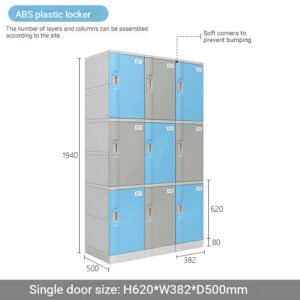
Rounded edges: 8mm radius on all edges reduces injury risk in high-traffic areas. Meets OSHA requirements for workplace safety.
Quiet operation: ABS doors close at 40-50 dB vs. metal 70-80 dB. Reduces noise pollution in shared spaces. Important for worker comfort and communication.
Lightweight construction: 60% lighter than steel equivalents. Easier for workers to open and close. Reduces strain on hinges for longer life. Safer in seismic zones.
Non-porous surface: Bacteria cannot penetrate. Easy to clean with standard disinfectants. No odor absorption. Resists mold and mildew growth.
Specifications
| Feature | Spec | Industrial Benefit |
|---|---|---|
| Material | High-impact ABS, injection molded | Chemical resistant, impact resistant, rustproof |
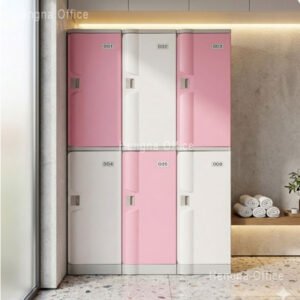
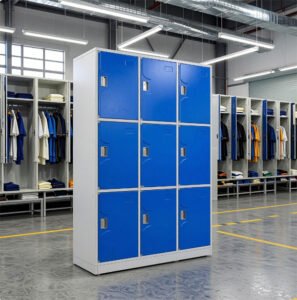
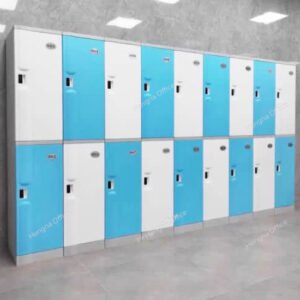
| Doors | 6 doors, 3 columns x 2 tiers | Individual compartments for each worker |
| Lock | Cam lock; combination or padlock hasp optional | Secure storage, no exposed metal components |
| Ventilation | Built-in louver vents | Airflow for damp work clothes and boots |
| Surface | Smooth, non-porous | Easy cleaning, no bacterial harborage |
| Colors | 8 standard + custom | Color-coding by department or shift |
| Chemical Resistance | Resists oils, greases, dilute acids, alkalis | No degradation from industrial chemicals |
| Impact Resistance | 15-20 joules without deformation | Withstands daily abuse from tools and equipment |
Compartment capacity: Each compartment accommodates work boots, coveralls, hard hat, gloves, personal items, and lunch bag. Ventilation slots allow airflow for damp work clothes.
10-Year Total Cost of Ownership
Steel lockers cost less at purchase but require annual painting, rust treatment, lock replacements, and repairs. Most are replaced after 5-7 years. ABS lockers cost more upfront but need only routine cleaning and occasional lock replacement for 15-20+ years.
Result: Roughly 55-60% lower total cost over 10 years for a typical installation, with break-even reached within 2-3 years.
Common Questions

Will ABS lockers hold up to forklift impacts?
ABS flexes on impact and returns to shape. Direct forklift strikes at moderate speed cause no permanent damage. For high-force impacts, ABS deforms rather than shattering—absorbing energy and protecting stored contents. Steel lockers dent permanently from the same impacts.
Can ABS handle temperature extremes in unheated warehouses?
Yes. ABS performs reliably from -20°C to 80°C. No brittleness in cold, no softening in heat. Material maintains impact resistance and structural integrity across the full range. Suitable for unheated warehouses, outdoor installations, and heated manufacturing areas.
How do we clean ABS lockers in dusty industrial environments?
Standard cleaning with damp cloth and mild detergent. Non-porous surface does not absorb dust or grease. For heavy soiling, pressure washing at standard industrial pressures (1,500-2,000 PSI) causes no damage. No special cleaning products required.
Can we color-code lockers by department?
Yes. 8 standard colors available. Custom Pantone color matching at 50+ units. Color runs through entire material—scratches don’t expose different colors. Common in automotive, aerospace, and pharmaceutical facilities for zone identification.
Industrial workplaces demand storage solutions that withstand chemical exposure, physical impacts, temperature extremes, and heavy daily use. ABS plastic industrial lockers deliver superior chemical resistance (inert to oils, greases, acids, alkalis), impact resistance (15-20 joules without deformation), zero rust or corrosion in any environment, 15-20+ year lifespan with minimal maintenance, and 56-62% lower total cost versus steel over 10 years.
The combination of durability, safety, and cost savings makes ABS plastic lockers the clear choice for factories, warehouses, logistics centers, and processing facilities. Contact us for industrial locker solutions that eliminate maintenance headaches and reduce long-term costs.