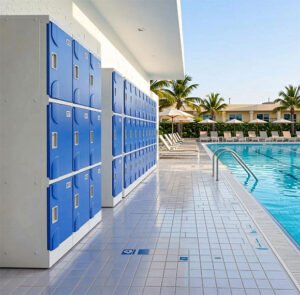
Easy-Clean 3-Door ABS Locker – Smooth Surface | for Food Industry Change Rooms | Audit-Ready
Food processing plants and commercial kitchens have the strictest locker room hygiene requirements of any industry. HACCP, BRC, and FDA audits all check staff change rooms. Lockers with crevices, porous surfaces, rust spots, or painted exteriors that peel will fail an audit. The cost of a failed food safety audit is not just a fine—it is production shutdown, product recalls, and reputation damage that takes years to recover.
Why Food Industry Auditors Look at Lockers
Food safety auditors know that staff change rooms are the boundary between outside contamination and clean production areas. They check lockers for: rust (indicates moisture problems and potential metal fragment contamination), peeling paint (physical contamination risk), gaps and joints (harborage points for pests and bacteria), and cleanability (can a sanitation worker actually clean every surface?).
Contamination pathway analysis:
- Staff arrive from outside environment carrying microorganisms
- Street clothes harbor bacteria, allergens, and foreign materials
- Change room is the control point where contamination must be stopped
- Lockers store both contaminated street clothes and clean work uniforms

Audit focus areas:
1. Physical contamination risks: Rust flakes, paint chips, metal fragments
2. Biological contamination risks: Bacteria harborage, mold growth, pest access
3. Chemical contamination risks: VOC emissions, material degradation
4. Cross-contamination risks: Mixing of clean and dirty items
5. Cleaning and maintenance: Can every surface be properly sanitized?
Real-world audit failure: A meat processing plant in Texas failed their SQF audit in 2022. The auditor identified rust spots on 30% of steel locker interiors, peeling paint on exteriors (physical contamination risk), visible mold in seams, and inability to clean welded joint areas. Result: major non-conformance, 30-day corrective action period, production halted.
Key audit standards: HACCP (no physical hazards, cleanable surfaces, no harborage points), BRC (storage facilities maintained, easy to clean, prevent pest access), FDA 21 CFR Part 117 (facilities prevent contamination, equipment cleanable), SQF (staff amenities hygienic, storage no contamination risk), FSSC 22000 (infrastructure supports food safety, cleaning verifiable).
Why Traditional Lockers Fail Food Safety Audits
Steel Lockers: Multiple Failure Points
Rust and corrosion: Indicates moisture problems. Rust flakes are physical contamination hazards. Rusty surfaces harbor bacteria in porous corrosion products. Auditors view rust as evidence of inadequate facility management.
Paint degradation: Paint chips are physical contamination risks. Peeling paint creates harborage points for bacteria. Cannot be effectively cleaned when paint is failing.
Welded seams and joints: Welds create crevices that harbor bacteria. Seam sealants degrade over time. Cannot be thoroughly cleaned in joint areas. Auditors specifically inspect welded areas.
Wood and Laminate Lockers
Moisture absorption: Wood absorbs moisture from humid environments. Swelling and warping create gaps. Mold grows in porous surfaces. Persistent musty odor indicates bacterial growth.
Hygiene issues: Cannot be sanitized to food industry standards. Surface degradation creates harborage points. Fails cleanability requirements consistently.
ABS Lockers: Designed for Food Industry Compliance
ABS (acrylonitrile butadiene styrene) is a non-porous, injection-molded plastic that meets food industry hygiene requirements. The key advantages for food processing environments:
Zero contamination risk:
- No rust, no paint chips, no metal fragments
- Non-porous surface prevents bacterial penetration
- No seams or joints that harbor bacteria
- Smooth surface allows thorough cleaning and sanitizing
Audit-ready design:
- Meets HACCP, BRC, FDA, SQF, FSSC 22000 requirements
- Cleanable with standard food industry sanitizers
- No VOC emissions or chemical degradation
- Maintains hygiene standards throughout 15+ year lifespan
Real-world validation: A poultry processing plant in Georgia installed ABS lockers in 2021. After 3 years of daily sanitizing with quaternary ammonium compounds: zero surface degradation, all doors operate smoothly, passed every audit with zero locker-related findings. Previous steel lockers had generated 12 audit findings in 2 years.
Specifications
| Feature | Spec | Food Industry Benefit |
|---|---|---|
| Material | ABS, injection molded, non-porous | No bacterial penetration, no rust, no paint chips |
| Surface | Smooth, joint-free, no-gap construction | Thorough cleaning possible, no harborage points |
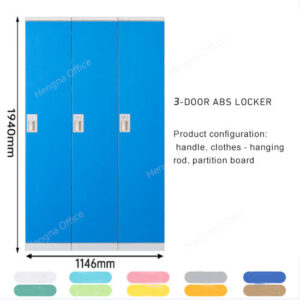
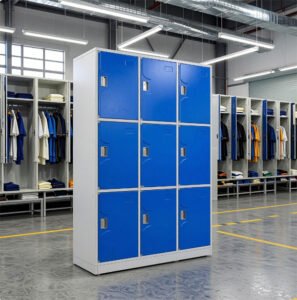
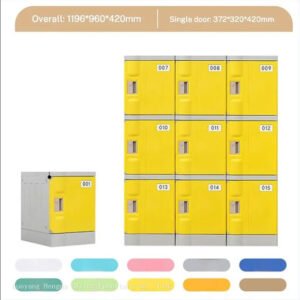
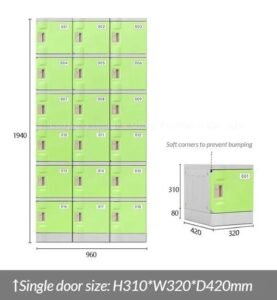
| Doors | 3 doors, 1 column x 3 tiers | Individual compartments for street clothes, work uniform, personal items |
| Lock | Cam lock; combination or padlock hasp optional | Secure storage, no exposed metal components |
| Colors | 8 standard + custom | Color-coding for zones or departments |
| Ventilation | Optional louver vents | Airflow for damp items, sealed option for dust-prone areas |
| Chemical Resistance | Resists quaternary ammonium, bleach, peracetic acid | Daily sanitizing does not degrade surface |
| Compliance | HACCP, BRC, FDA, SQF, FSSC 22000 | Audit-ready from day one |
Dual-zone design: Upper compartment for clean work uniform, lower compartment for street clothes and personal items. Physical separation prevents cross-contamination. Some facilities add middle compartment for shoes.
Chemical resistance: ABS resists common food industry sanitizers including quaternary ammonium compounds, sodium hypochlorite (bleach), peracetic acid, and hydrogen peroxide. Daily sanitizing does not degrade surface, discolor material, or compromise structural integrity.
10-Year Total Cost of Ownership
Steel lockers in food plants need regular repainting, rust treatment, and repairs—and most are replaced within 4-6 years. ABS lockers need only routine cleaning.
Beyond maintenance, locker-related audit findings can trigger corrective action periods, production shutdowns, and recalls. The cost of one failed audit can exceed the entire locker installation. ABS lockers eliminate locker-related audit findings entirely.
Result: Roughly 60-70% lower total cost over 10 years for a typical installation.
Common Questions

Will ABS hold up to daily pressure washing?
Yes. ABS is waterproof and injection-molded in one piece—no seams for water to penetrate. Pressure washing at standard food industry pressures (1,500-2,000 PSI) causes no damage. The non-porous surface sheds water and dries quickly.
Can we color-code lockers by department or zone?
Yes. 8 standard colors available. Custom Pantone color matching at 50+ units. Many food plants use different colors for production, maintenance, office, and visitor zones. Color runs through entire material—scratches don’t expose different colors.
Do ABS lockers meet specific food safety certifications?
ABS material is FDA-compliant for food contact. The locker design meets HACCP, BRC, SQF, and FSSC 22000 requirements for staff facilities. We provide compliance documentation with each order.
How do we handle dual-zone clean/dirty separation?
Standard 3-door design provides upper compartment for clean uniform and lower for street clothes. Physical separation prevents cross-contamination. Optional middle compartment for shoes. Some facilities add antimicrobial additives for enhanced protection.
Food processing plants and commercial kitchens cannot afford locker-related audit failures. ABS plastic easy-clean food industry lockers deliver zero contamination risk (no rust, no paint, no metal fragments), joint-free construction with no harborage points, chemical resistance to daily sanitizing, 15+ year lifespan with zero maintenance, and elimination of locker-related audit findings.
The long-term savings versus steel make the investment decision straightforward. More importantly, ABS lockers eliminate the risk of production shutdowns, product recalls, and reputation damage from audit failures.
Contact us for food industry locker solutions that pass every audit.