ABS Sauna and Steam Room Lockers — The Heat-Resistance Question Most Buyers Forget to Ask
Ask ten buyers shopping lockers for a sauna project what they check first, and nine will say waterproofing. That is the wrong first question. Water is only half of what a spa changing area throws at a cabinet — the other half is continuous warmth that softens the wrong plastics, cooks cheap lock electronics and blisters painted steel. This guide covers what sauna and steam room environments actually measure, the heat questions worth asking any supplier in writing, and how buyers configure ABS locker banks for spa projects. Specs reflect Hengna’s 2026 ABS locker range.

How Hot Do Sauna and Steam Rooms Actually Run
The numbers surprise people who have only seen spa brochures. A traditional Finnish-style sauna holds 65 to 90 °C at upper bench height. A steam room runs cooler in temperature — roughly 40 to 45 °C — but carries near-100% humidity, which makes the felt temperature heavier. Infrared cabins sit between 45 and 60 °C. The changing area and corridor outside usually stay around 22 to 25 °C.
| Space | Typical air temperature | Humidity |
|---|---|---|
| Sauna cabin (upper bench) | 65–90 °C | Dry, 10–20% |
| Steam room | 40–45 °C | Near 100% |
| Infrared cabin | 45–60 °C | Dry |
| Changing area / corridor | 22–25 °C | Elevated, spikes after sessions |
Here is the practical point behind those numbers: nobody should mount guest lockers inside the hot room itself. The locker zone sits in the warm, damp band between the cabin door and the outside corridor — and that band is exactly where weak materials fail first.
The Question Most Buyers Forget: Heat Distortion
Waterproofing gets a spec sheet; heat usually gets a shrug. That is backwards, because heat is what quietly damages the parts nobody inspects. Before signing anything, put these five questions to the supplier:
- What continuous air temperature are the door panels rated for? Get the heat distortion figure in writing, not as a verbal “it’s fine”.
- What happens to the doors after months at 60–70 °C? Long exposure tests matter more than momentary ratings.
- What is the minimum clearance from the stove wall or flue run? A cabinet parked against a hot wall lives a different life than one two meters away.
- What temperature range are the lock electronics rated for? Code and RFID locks contain boards and batteries; heat and condensation kill cheap ones within a season.
- Is ventilation designed into the bank? Towels hung inside overnight keep a sealed compartment damp until morning.
A supplier who answers all five without hesitating has built for spas before. One who answers none has sold the same cabinet to a school and called it a day.
Why ABS Holds Up Where Coated Steel and Wood Fail
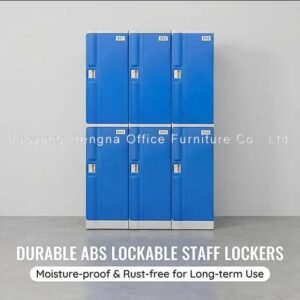
ABS lockers are injection molded as single panels, so there is no laminate to delaminate and no coating to blister when the room warms up. Color runs through the panel. Steel behaves differently: it conducts heat, so handles and hinges on a steel cabinet near a sauna wall get uncomfortable to touch, and every fastener hole is a place for moisture to work in. Wood simply swells once its surface film cracks.
Honesty requires the other side of the story too. ABS is a thermoplastic — park any plastic cabinet directly against a sauna stove and it will eventually deform, no matter what the brochure implies. That is why placement, covered below, does half the work. The material argument only holds when the cabinet sits in the warm zone, not in the hot one.
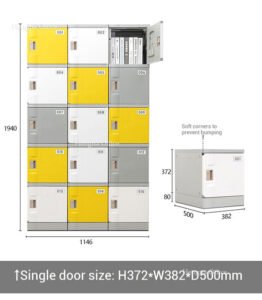
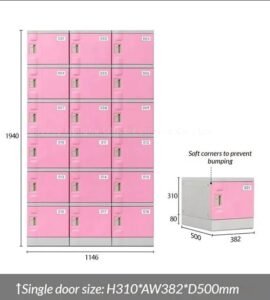
Construction details compound the advantage. Hengna’s ABS lockers use a mortise-and-tenon snap assembly — no screws, no glue — so nothing rusts loose or works free as the room cycles between warm and cool through the day. Molded design life exceeds 20 years.
Placement Rules That Prevent Heat Problems
Most “plastic locker melted in the spa” complaints trace back to placement, not polymer. Four rules keep the warranty conversations short:
- Keep banks out of the cabin. Lockers belong in the changing area, where air stays below 30 °C even on full sessions.
- Leave a gap from heat sources. One meter minimum from stove walls, flue runs and radiator panels; more if the wall reads warm to a flat hand.
- Lift the cabinet off wet floors. The 80 mm molded base keeps door edges above mop water and splash.
- Spec locks by zone. Key locks tolerate heat better than the electronic options; put code and RFID locks on banks in the cooler end of the changing area.
Because the snap-fit design assembles and re-assembles without tools, a bank installed in the wrong corner during fit-out can be moved the same afternoon — no re-drilling, no patch panels.
What a Spa Project Order Actually Looks Like
A 600-square-meter club with one sauna cabin, one steam room and a heated pool typically mixes configurations rather than ordering one block:

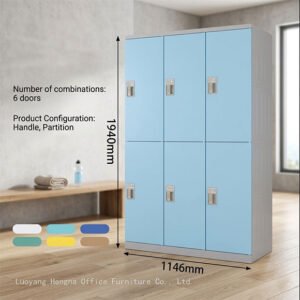
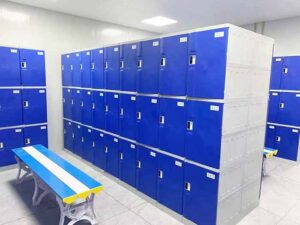
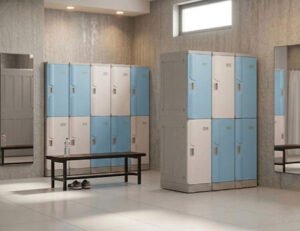
- Six-door banks near the showers — 930 mm door modules, three across and two tiers up, combination locks so guests carry no keys into the water.
- Full-height single-door columns by the dry wall — key locks, for members who change, shower and leave a bag for the afternoon.
- Staff bank in the back corridor — RFID card locks tied to shift cards.
- Matching ABS benches — 900 to 2000 mm lengths in the same color program, so slatted wood benches (the other thing that rots in spas) leave the room entirely.
Color does quiet operational work here. Two of the 8 standard colors per zone — say warm tones near the sauna wing, cool tones near the pool — cut lost-member questions at reception more than any signage budget does.
Ordering From Hengna
Luoyang Hengna Office Furniture Co., Ltd. supplies the ABS locker and bench range on a manufacturer-direct basis for spa and wellness projects, with OEM support covering silk-screen logos, custom packaging and custom manuals. Banks ship knock-down in foam and corner-guard packing, assemble tool-free on site, and carry a one-year warranty. Send the room layout and door count, and a quote comes back within 24 hours.
Common Questions
Will ABS lockers deform inside a sauna cabin?
They are not specified for inside the hot room, and neither is any locker material worth buying. Placed in the changing area the way spas actually lay out, panel temperature stays far below the range where ABS softens. Ask for the heat distortion figure in writing with your quote.
What is the minimum order quantity?
Sample orders covering a single changing room are accepted; container quantities bring the better unit pricing. Share your layout and lock mix for an exact figure.
Can the club logo go on the doors?
Yes. Silk-screen printing, custom packaging and custom manuals are standard OEM options on volume orders.
Which lock type holds up better in a spa?
Key locks handle heat zones with the least fuss. Combination and RFID locks belong on banks in the cooler end of the changing area, and their electronics rating is worth confirming with any supplier before ordering.
Sizing this against other configurations? Every model we build sets them out in one place, ordered by how many people each unit serves.
FOB or CIF — how do you quote?
Both. Send the destination port and preferred terms; the quote with warranty, lock options and current lead time comes back within 24 hours.