Degreaser and Sanitiser Cycles: Which Locker Surfaces Survive Food Plant Cleaning
A food plant cleaner with a spray bottle decides more about locker lifespan than the material datasheet does. Chlorine, quaternary ammonium, peracetic acid and alkaline degreasers all attack different things, and a surface that survives one may fail at another within a year.
This page sets out which surfaces tolerate which cleaning chemistry, and where the honest limits are. It is written for buyers who have been told “ABS is chemical resistant” and want to know what that actually covers.
The Five Cleaning chemistries That Matter
Most food plant cleaning falls into five families. The compatibility question is not “is it chemical resistant” but “which of these five will this surface meet, and how often”.
| Chemistry | Common use | Aggressive to |
|---|---|---|
| Sodium hypochlorite (chlorine) | General disinfection, floor wash | Metals, some plastics at high concentration |
| Quaternary ammonium | Surface sanitiser, food contact | Low aggression; residue builds up |
| Peracetic acid | High-care disinfection | Metals, seals, some coatings |
| Alkaline degreaser | Fat and protein removal | Coatings, painted surfaces, aluminium |
| Solvent-based | Adhesive and grease removal | Most plastics, most coatings |
A plant usually uses three or four of these on a daily cycle, not one. That combination — not any single chemical — is what ages a locker.
Four Surfaces, Side by Side
| Surface | Chlorine | Quat sanitiser | Peracetic | Alkaline degreaser | Solvent |
|---|---|---|---|---|---|
| ABS | Good | Good | Moderate | Good | Poor |
| Powder-coated steel | Poor at seams | Good | Moderate | Poor | Poor |
| 304 stainless | Moderate | Good | Moderate | Good | Good |
| HDPE | Good | Good | Moderate | Good | Poor |
Read the table as a starting point, not a specification. Actual performance depends on concentration, contact time and temperature, and no table replaces the material supplier’s own data. The wet-area range covers the models these surfaces are used in.
Two patterns are worth noticing.
ABS and HDPE behave similarly on most chemistries, because both are thermoplastics with no coating. The difference is mechanical: HDPE is softer and scratches more.
Powder-coated steel fails at the seams first. The coating itself handles most sanitisers; the problem is the folded seam where water and chemical sit together and the coating cannot reach. That is why a steel locker can look intact and still be corroding from the inside.
Where ABS Genuinely Wins
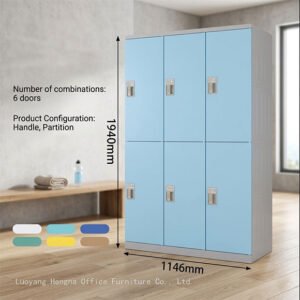
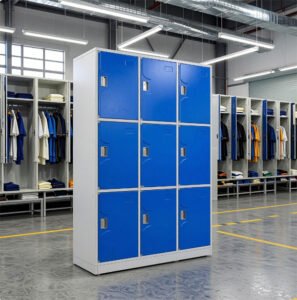
Three situations where the plastic body is the right answer, and the reason is structural rather than chemical.
Washdown with chlorine. ABS handles repeated hypochlorite exposure without the surface breaking down. The body does not absorb water, so there is no path for chemical to get behind a coating.
No coating to chip. A chipped coating on steel is where corrosion starts, and it usually happens at the edges and around fixings — exactly where cleaning is hardest.
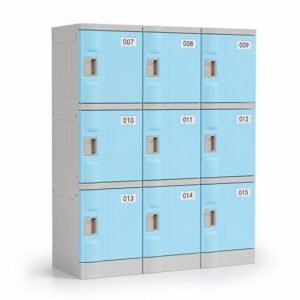
Seamless moulded panels. No folded seam means no place for residue to collect. In a plant that swabs for protein residue, that matters more than the chemistry table.
Where ABS Has Limits
Being straight about this is more useful than another compatibility chart.
Solvent-based cleaners will dull it. Not immediately, and not catastrophically, but a surface dulled by solvent holds dirt better than the original finish. If the plant uses solvent degreasers on the floor near the lockers, expect the lower panels to lose their finish within a couple of years.
High-temperature washdown is a different question. ABS softens well above normal washdown temperatures, but steam cleaning at close range is not the same as a hose. Check before specifying for a steam-clean regime.
Colour and chemical resistance are separate. A pigmented panel and a natural one behave slightly differently. Where a plant uses aggressive chemistry, ask for the specific colour’s data rather than assuming all colours match.
Residue, Swabs and What They Find
Chemical resistance is only half the story in a plant that swabs surfaces for protein residue. The other half is whether the surface can be cleaned back to a pass.
Three design details decide that more than the material does.
Seams and joints. A folded seam holds residue, and a swab will find it. Moulded panels have no seam to trap material, which is why the swab result tends to be better on plastic bodies than on coated steel with folded edges.
Fixings at low level. Screws and brackets near the floor collect soil and are hard to reach with a cloth. Where they corrode, the surface around them becomes a cleaning problem rather than a fixing problem.
Internal corners. A radius that wipes clean in one pass beats a square corner that needs a brush. This matters most at the base of the compartment, where boots and wet kit sit.
One point that rarely appears on a datasheet: cleaning chemistry leaves residue of its own. Quaternary ammonium sanitisers build a film on non-porous surfaces, and that film eventually attracts soil. A plant using quat daily should include a periodic rinse in the schedule, or the surface will look clean and still fail a swab.
The same logic applies to layout as to surface: what cannot be reached cannot be cleaned, which is why zone planning and material choice belong in the same conversation.
Stainless: When It Is Worth the Cost
Stainless earns its price in three situations: high-temperature washdown, heavy impact, and areas where a metal surface is simply expected by the auditor.
It is not automatically more chemical-resistant than ABS. 304 stainless is attacked by chlorine at concentration and by peracetic acid over time, and the failure mode — pitting — is harder to spot than a dulled plastic panel.
Where stainless does win clearly: kitchens with steam, areas with trolley impact, and any location where the cleaning regime includes high-pressure hot water.
The Question to Ask Before Choosing
Ask the site for the cleaning schedule, not the chemical list.
A list of chemicals tells you what is on site. A schedule tells you what each surface meets, how often, at what concentration and how long it stays wet. That combination is what decides lifespan.
Three things to ask for specifically:
- Which sanitiser is used daily, and at what dilution
- Whether any solvent or adhesive remover is used near the lockers
- Whether the plant steam-cleans or hoses
With those three answers, the material choice usually makes itself.
FAQ
Is ABS resistant to chlorine?
Yes at normal washdown concentrations. Very high concentrations with long contact time will dull the surface over years.
Can I use solvent degreaser on ABS lockers?
It will clean them, and it will dull the finish. Avoid routine use near the panels.
Is stainless steel better than ABS in a food plant?
Only where heat, impact or audit expectation dominates. For chlorine-based washdown, ABS is usually the more durable body.
Do coloured lockers resist chemicals differently?
Slightly. For aggressive regimes, ask for data on the specific colour rather than the material family.
How long will ABS last in a washdown area?
The body typically outlasts the fixings. Check hinge and lock material, because those fail first.
Comparing this against other door counts? The full ABS locker range has the same data for every size, so you are not comparing across five tabs.
Ask for the Cleaning Schedule First
Most buyers start with the material and then discover the cleaning regime. Reverse it.
Get the daily sanitiser, the dilution and the contact time on paper, then ask which surface is warranted against that. A supplier who answers without asking is selling a material, not a solution — and in a plant that washes down twice a day, the difference shows up in year two. Where the same site also washes down wet areas outside production, check both regimes rather than assuming one covers the other.
Updated November 2026.