Why Coatings Fail in Humid Locker Rooms: The Material Science Behind Locker Corrosion
Every painted steel locker that rusts does so for the same reason: the coating system failed before the steel did. Understanding why coatings fail ??and why some materials do not need them ??changes how you evaluate locker specifications for humid environments. This article explains the three coating failure mechanisms that affect locker rooms and the material-level alternatives that avoid them entirely.
How a Coating System Actually Works (and Why It Is Fragile)
A powder-coated steel locker door is not a single material ??it is a two-material system: a steel substrate and a polymer coating bonded to its surface. The coating’s job is to be a continuous, impermeable barrier between the steel and the environment. As long as the barrier is intact, the steel cannot corrode because the corrosive agents ??water, oxygen, chlorides ??cannot reach it.
The fragility is in the word “continuous.” A coating must be flawless across every square millimeter of the locker surface, including edges, corners, hinge points, around rivets, inside lock bodies, and along folded seams where the coating thickness varies. If any single point on that surface loses coating integrity, corrosion begins at that point and spreads laterally beneath the still-intact coating around it. One pinhole is all it takes.
This is fundamentally different from a solid-color plastic like ABS. In a solid-color material, there is no barrier to breach because there is no separate coating. The surface of an ABS locker door is the same material as the interior ??scratch it, and the revealed material is identical to the surface. The scratch is cosmetic. On a coated steel door, a scratch that penetrates the coating is a corrosion initiation site.
Failure Mechanism 1: Osmotic Blistering
Osmotic blistering is the most common coating failure in locker rooms, and it is the one that most confuses facility managers because the coating looks intact right up until it does not. The mechanism works like this:
- Water vapor permeates the coating ??all polymer coatings are slightly permeable to water at the molecular level, even when they appear solid and continuous to the eye.
- If there are any soluble contaminants on the steel surface beneath the coating (salts, oxides from incomplete surface preparation, cleaning residues), the permeating water dissolves them.
- The dissolved contaminants create an osmotic gradient ??the concentration of dissolved material is higher under the coating than outside it, so more water is drawn through the coating to equalize the concentration.
- Pressure builds under the coating as the liquid volume increases. Eventually the coating blisters ??a visible dome where the coating has separated from the steel.
- The liquid inside the blister is now a corrosive electrolyte in direct contact with bare steel. Corrosion accelerates rapidly from this point.
The key insight: osmotic blistering does not require a scratch, a chip, or any visible damage. It can initiate beneath a coating that looks brand new. The root cause is soluble contamination on the steel surface before coating ??a manufacturing quality issue, not a maintenance issue.
Failure Mechanism 2: Filiform Corrosion
Filiform corrosion is what happens after the coating is breached ??by a scratch, an edge wear point, or a fastener hole. It appears as thin, worm-like threads of corrosion spreading beneath the coating, typically 0.5 to 2 millimeters wide and following seemingly random paths across the surface.
The mechanism: oxygen and water enter at the breach point. An electrochemical cell forms ??the breach acts as the anode (where metal dissolves), and the area just ahead of the advancing corrosion filament acts as the cathode (where oxygen is reduced). The filament advances because the cathode reaction pulls oxygen through the coating, and the anode reaction dissolves steel at the filament tip. The filament head is acidic (pH 1 to 4), which accelerates the steel dissolution ahead of it. The filament tail is filled with porous corrosion product that trails behind the advancing head.
Filiform corrosion cannot be stopped by simply painting over it. The active filament head is electrochemical, not just chemical ??it generates its own acidity and continues advancing as long as oxygen and water are available. The only reliable remediation is mechanical removal: sanding or grinding away all affected coating and corrosion product until bare, clean steel is exposed, then re-coating from scratch. This is why “spot painting” rust spots on lockers is a temporary measure ??the filiform filaments that were not visible continue advancing beneath the adjacent coating.
Failure Mechanism 3: Edge Creep
Edge creep is the progressive loss of coating adhesion starting at cut edges, folded seams, and punched holes. During manufacturing, the coating is applied to flat sheet steel before the sheet is cut and formed. The cut edges expose bare steel ??there is no coating on the edge itself. The coating on the adjacent flat surface provides some protection through overlap, but the edge remains the weakest point in the system.
In a locker door, the door edges are cut surfaces. Every time the door closes, the edge contacts the frame. This is a wear point. As edge coating degrades and steel is exposed, corrosion initiates at the edge and creeps inward under the intact coating on the door face. The visible rust at the edge is typically only a fraction of the corrosion spreading beneath the adjacent paint.
Edge creep is the reason that locker doors rust at the edges first. It is not that the edge gets more abuse ??though it does. It is that the edge is the weakest point in the coating system from the moment of manufacture, and every door operation cycle wears it a little more.
Material-Level Alternatives: What Through-Body Color Means in Practice
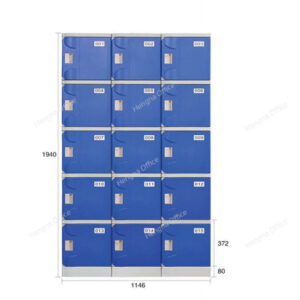
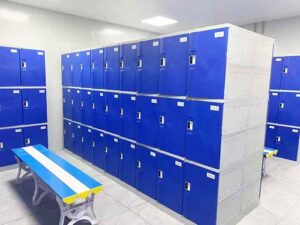
A material with through-body color ??ABS plastic, for example ??eliminates all three failure mechanisms simultaneously because there is no coating to fail. Osmotic blistering requires a coating-substrate interface; no coating means no interface. Filiform corrosion requires a metal substrate; no metal means no electrochemical cell. Edge creep requires a cut edge with exposed substrate; a uniform material has the same composition at the edge as on the surface.
This is not an argument that ABS is a “better” material than steel in absolute terms. Steel is stronger, stiffer, and has higher temperature resistance. These are real material advantages. The argument is about the coating system ??any material that relies on a surface coating for corrosion protection introduces coating failure as a failure mode. In a dry environment, coating failure may never occur within the facility’s planning horizon. In a wet, humid, or coastal environment, coating failure is not a possibility ??it is a schedule.
Selection Criterion: When Coatings Are Acceptable and When They Are Not
- Climate-controlled indoor, low humidity, low traffic: Powder-coated steel is a reasonable choice. The coating will likely outlast the facility’s renovation cycle.
- Indoor with intermittent humidity (gym changing rooms, dorm bathrooms): Coated steel will fail eventually. The question is whether the failure timeline (typically 3 to 5 years for visible rust) is acceptable for the facility’s maintenance planning.
- Continuously humid (pool decks, spa wet areas, tropical indoor without HVAC): Coated steel will fail predictably. Budget for repainting as a scheduled operating expense or select a material that does not require coating.
- Coastal, outdoor, or chemical-exposed: Coating failure is accelerated by salt, UV, or chemical attack. In these environments, the coating system is the weakest link in the specification, and material selection should focus on eliminating that link.
Frequently Asked Questions
Q: Can a thicker coating prevent these failure mechanisms?A thicker coating delays osmotic blistering and edge creep by increasing the distance water must travel to reach the steel and the distance corrosion must travel to become visible. It does not change the underlying mechanism. For filiform corrosion specifically, coating thickness has minimal effect because the filament head generates its own acidic environment that attacks the steel regardless of coating thickness above it. Q: If I have existing steel lockers with early-stage rust, can I save them?
Yes, if the corrosion is caught early and mechanically removed ??sanding to bare metal, chemical treatment to passivate the surface, then re-coating with proper surface preparation. The key phrase is “early stage.” Once filiform corrosion has spread more than a few millimeters from the visible rust spot, the affected area is larger than the operator is likely to sand, and the corrosion will return. The decision to repair vs replace should be based on the percentage of doors showing rust beyond what a maintenance crew can fully remediate in the available maintenance window.