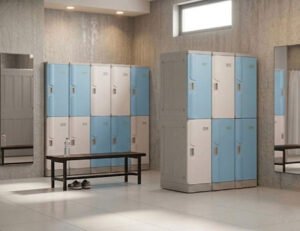
Why Do Steel Lockers Rust in Pool Changing Rooms? 7 Causes and the ABS Plastic Fix
If you manage a public pool, a hotel spa, or a water park, you have seen it: locker doors with bubbling paint along the bottom edge, rust streaks running down from the hinge, that orange-brown dust that stains towels and swimsuits. Steel lockers in pool changing rooms rust. Everyone knows this. What most facility managers do not know is why it happens so much faster around pools than anywhere else ??and that the fix is simpler than they think.
The Chlorine Problem Most Facility Managers Do Not See Coming
Pool water contains chlorine at 1 to 3 parts per million. That is low enough to be safe for swimmers but high enough to off-gas continuously into the air. In an enclosed changing room with limited ventilation, airborne chlorine compounds settle on every surface ??including locker doors. Chlorine is a halogen. It attacks the zinc in galvanized steel and the polymer bonds in powder coating. You cannot smell it doing the damage, but it is working 24 hours a day, 365 days a year.
One aquatic center operator we worked with measured the air in their changing room and found chlorine concentrations 8 times higher than the pool deck itself. Why? Because wet swimmers bring chlorinated water into a smaller, less ventilated space on their skin and suits. The locker room becomes a chlorine concentration chamber. Steel lockers are the first to show the damage.
7 Reasons Steel Lockers Fail in Wet Changing Rooms
It is never just one thing. Steel locker rust in pool environments is a chain of failures. Here are the seven links:
- Chlorine vapor attacks powder coating. The coating develops microscopic cracks within 12 to 18 months. Once the steel substrate is exposed, rust begins ??from the inside of the coating outward.
- Condensation inside the locker. Wet swimsuits and damp towels go into a sealed steel box. The interior humidity hits 95 percent or higher. Steel lockers have no ventilation. The moisture has nowhere to go.
- Scratch-to-rust chain reaction. A locker door gets scratched by a bag zipper or a locker key. Powder coating peels at the scratch edge. Water seeps under. Rust spreads underneath the intact coating like rot under paint on a car.
- Bottom-row flood exposure. The lowest row of locker doors sits 50 to 100 mm above a floor that is wet for hours every day. Splash, mop water, and standing puddles keep the bottom edge perpetually damp.
- Salt air acceleration. Coastal pools ??Miami, Gold Coast, Phuket, Dubai ??add airborne salt to the chlorine equation. Salt and chlorine together corrode steel roughly 3 times faster than chlorine alone.
- No passive ventilation. Steel lockers are designed as sealed boxes for security. That seal becomes a moisture trap. The humidity inside a steel locker at a busy pool can reach condensation point within 20 minutes of a wet item being placed inside.
- Cleaning chemical exposure. The quaternary ammonium disinfectants used to clean locker room floors and benches are corrosive to steel. Maintenance staff spray these daily. Overspray lands on locker doors. The chemical residue accelerates coating breakdown.
What ABS Plastic Lockers Do Differently
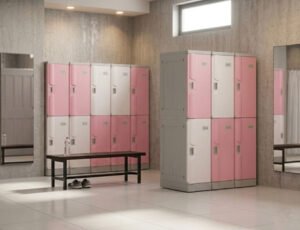
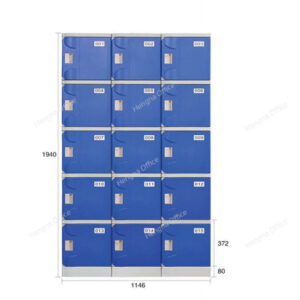
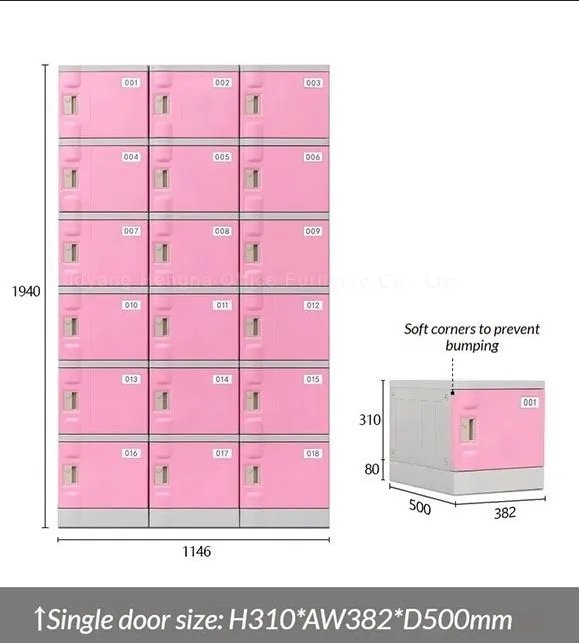
ABS (acrylonitrile butadiene styrene) is a thermoplastic polymer. There is no coating to crack, no substrate to rust, and no metal to corrode. Every component ??door, body panel, hinge, shelf ??is the same material all the way through. Scratch an ABS door and you reveal more ABS. There is nothing underneath that can rust.
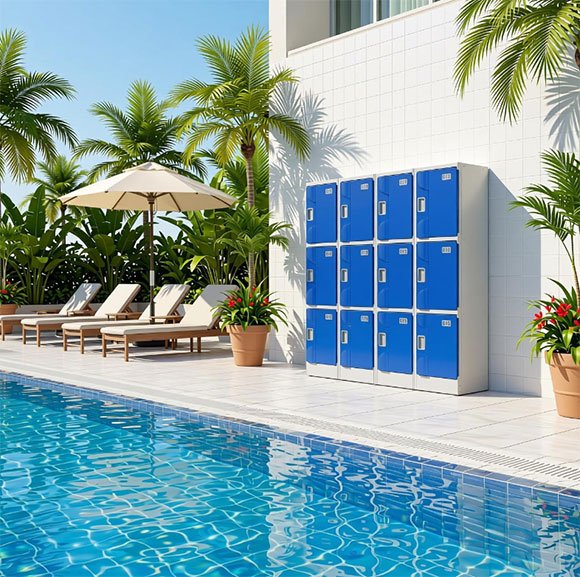
ABS lockers also include built-in door vents. The vents are louvered to prevent anyone from seeing inside, but they allow continuous passive airflow. A wet swimsuit inside a vented ABS locker dries slowly instead of creating a sauna. Lower humidity inside means fewer odors and no condensation damage. For pool environments specifically, ABS lockers can be specified with UV stabilizers for outdoor-adjacent installations and with a sloped top option that prevents water from pooling on the locker surface.
What Pool Locker Maintenance Looks Like: Steel vs ABS
For a medium-sized public pool with a 50-door locker bank, the difference in maintenance workload is stark:
| Maintenance Activity | Steel Lockers | ABS Lockers |
|---|---|---|
| Rust treatment and repainting | Required quarterly ??labor plus materials | Not needed ??cannot rust |
| Door replacement due to corrosion | Average 5 to 8 doors per year | Zero |
| Cleaning labor (weekly) | Heavy ??rust spot treatment adds time | Light ??wipe-down only |
| Guest complaints about rusty lockers | Common, especially on review sites | None reported |
| Maintenance cost difference | Baseline | Fraction of steel locker cost |
The maintenance savings typically cover the upfront cost difference within the first 3 to 4 years of operation. After that, the ABS locker bank is essentially running at near-zero maintenance cost while the steel locker bank continues to require quarterly rust treatment, periodic door replacements, and eventually a full repaint cycle.
How to Tell If Your Current Lockers Are Already Failing
Walk your locker room and look for these early-warning signs:
- Paint bubbling or blistering on the bottom 150 mm of any door
- Rust-colored drip marks below hinges or lock plates
- Orange staining on the locker frame where doors meet the body
- Doors that no longer close flush ??rust has swollen the hinge area
- A metallic, musty smell when you open a locker that has been closed overnight
If you check three or more of these boxes, your lockers are in the replacement window. The cost of waiting is not just maintenance ??it is the guest experience. No one posts a review about great lockers. But “rusty, smelly lockers” shows up in negative reviews more often than you would think.
Frequently Asked Questions
Can ABS lockers handle the chlorine in pool air?
Yes. ABS is chemically inert to chlorine compounds at the concentrations found in pool air. There is no coating to degrade and no metal to corrode. The material is also resistant to quaternary ammonium disinfectants used in locker room cleaning.
Do ABS lockers look cheap compared to steel?
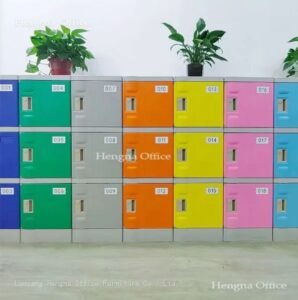
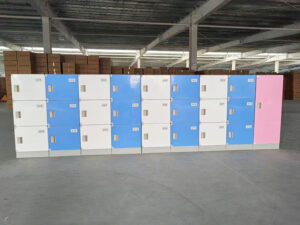
Modern injection-molded ABS lockers have a smooth, clean finish that does not chip, fade, or develop patchy rust spots over time. Three years in, an ABS locker bank typically looks newer than a steel locker bank of the same age. Colors are molded through the material, not painted on, so scratches do not reveal a different color.
What is the delivery time for a pool locker project?
Standard ABS locker orders ship within 15 to 25 business days. For projects of 100 doors or more, allow 4 to 6 weeks for production and sea freight. Air freight is available for urgent projects and typically adds 5 to 7 days.